
December 22, 2025
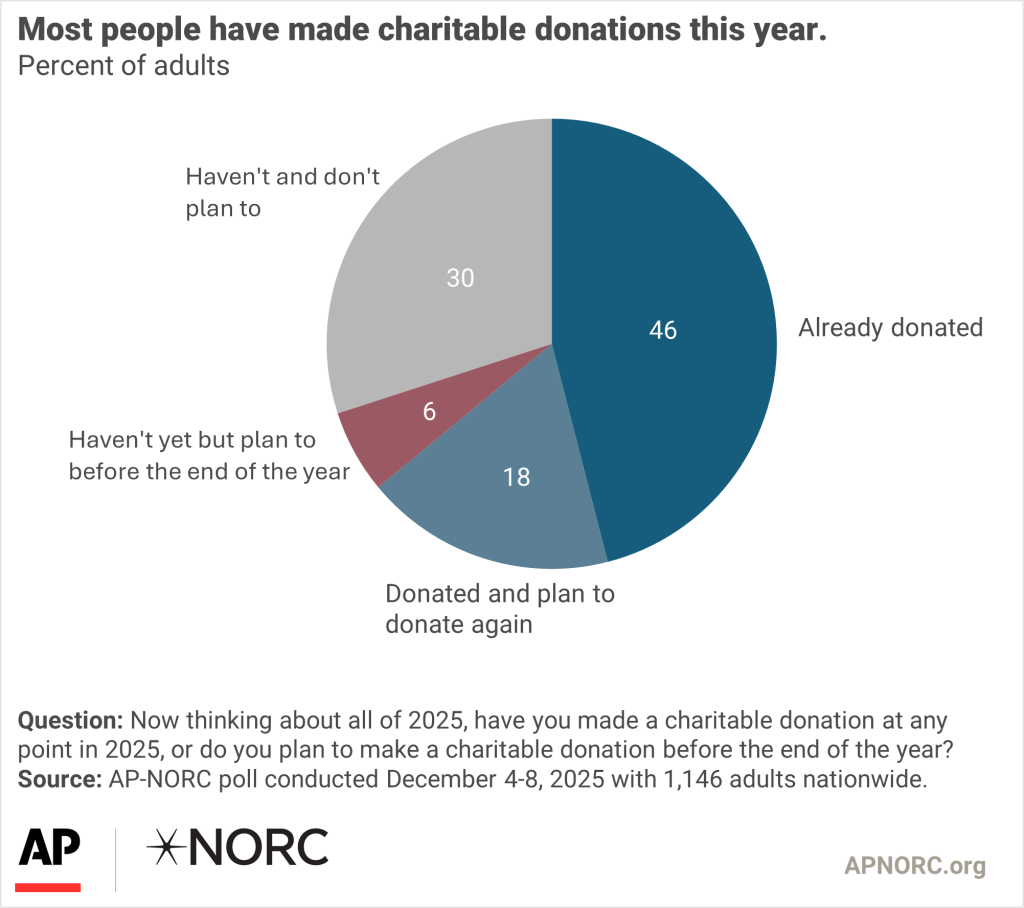
About half have already made a charitable donation this year while 2 in 10 have donated and plan to donate again before the year ends. About a third have not donated yet and do not plan to donate. Very few are planning to donate for the first time before the year ends.
Adults ages 18-45 are more likely than adults 45 and older to have not donated and not plan to (36% vs. 24%).
The public has donated in a variety of ways. About 4 in 10 gave money to someone they knew personally, donated while checking out at a store, or provided non-financial support to people in their community. Three in 10 volunteered their time to a charitable organization. Few, only 12%, donated to a charity on Giving Tuesday, the Tuesday after Thanksgiving.
College educated adults were more likely to give financial support to someone they know personally, volunteer their time, or provide non-financial support to people in their community.
Adults ages 45 and older were also slightly more likely to volunteer their time this year (33% vs. 22%) or give to charity while checking out at a store (45% vs. 37%) compared with younger adults.

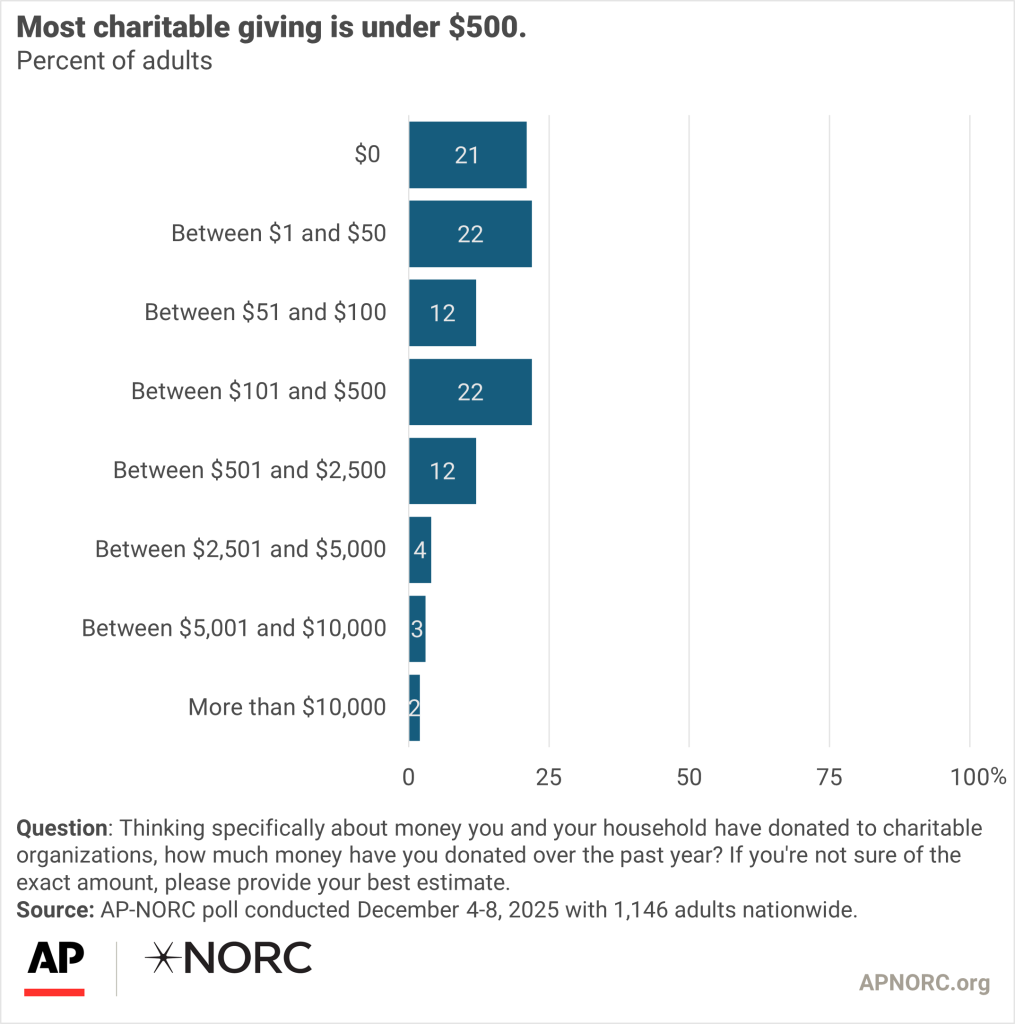
While 30% say they personally haven’t donated and don’t plan to do so before the end of the year, only 21% say their household has not contributed any money in the past year. Most are donating modest amounts. Two in 10 donated between $1 and $50 dollars and a third donated between $51 and $500. Few donated more than $500.
Adults with household incomes of at least $100,000 annually (61%) were more likely to donate upwards of $100 compared to adults with household incomes between $50,000 and $100,000 (40%) or adults with a household income of less than $50,000 (30%). This gap narrows slightly for donations above $500 with fewer households donating that amount. About a third of households with annual incomes of at least $100,000 donated at least $500 (32%), compared with 22% of households with annual incomes between $50,000 and $100,000 and 11% of households with incomes of less than $50,000 per year.
The share of adults who report their households already donated between $1 and $50 this year (22%) is up from 12% earlier this year according to the March AP-NORC poll.
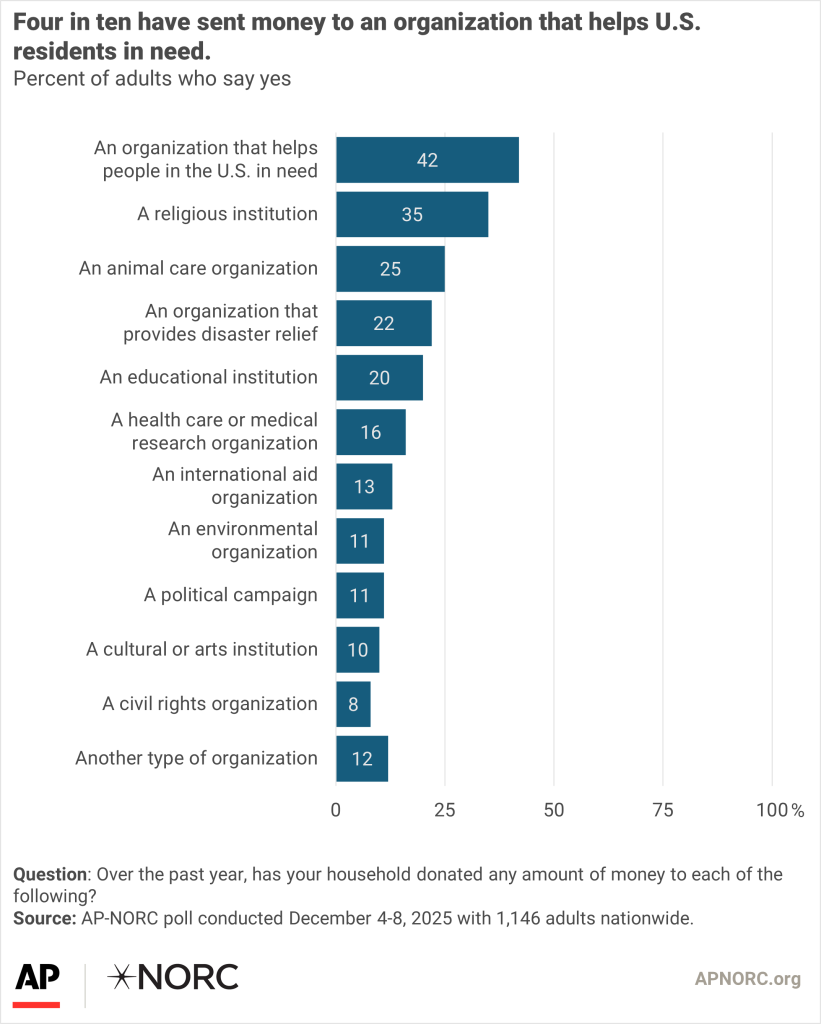
About 4 in 10 say their household has donated to an organization that aids people in the U.S. and 35% gave to a religious institution. Other common recipients include animal welfare organizations, organizations focused on providing disaster relief, and education or healthcare organizations.
Americans are donating their money in similar ways as seen in the March AP-NORC poll.
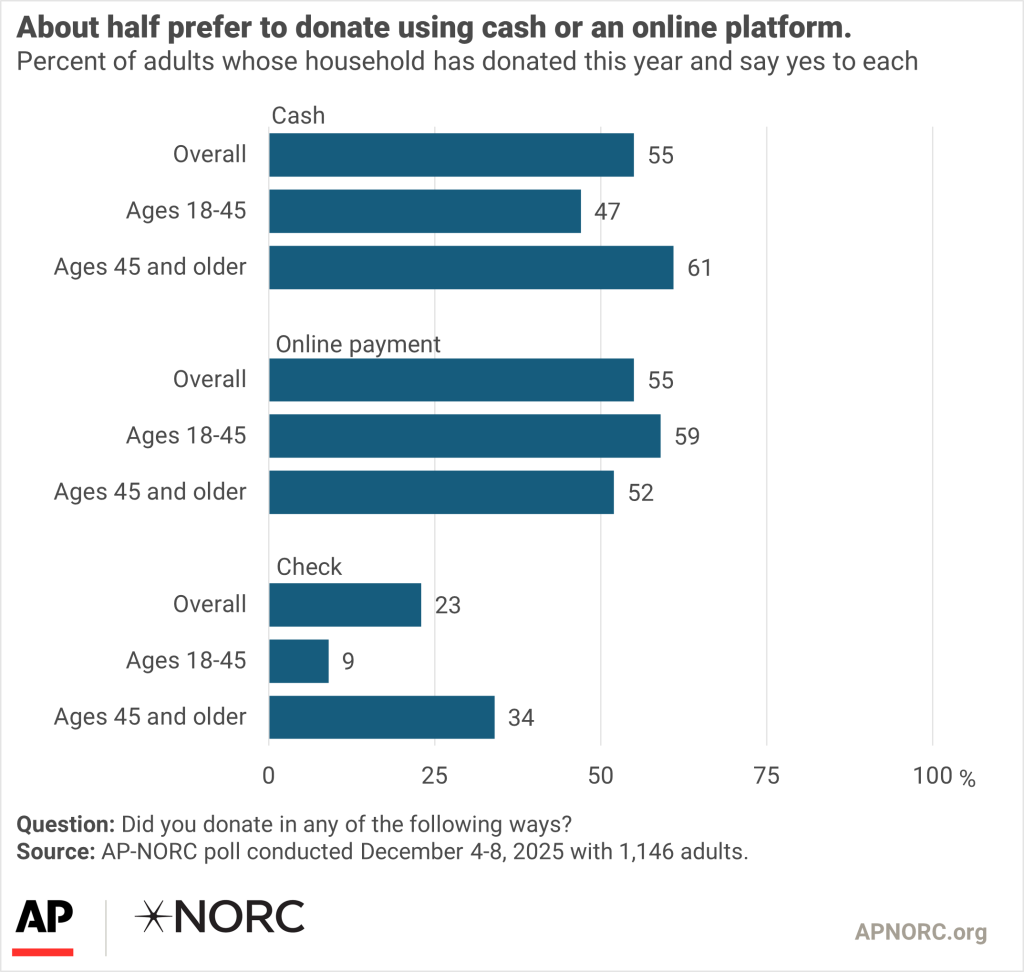
Among those who say their household has donated at least one dollar in the past year, about half have made the contributions via either cash or online payment. Around a quarter gave money via check.
Using either cash or a check to give money is more popular among donors ages 45 and older. Donating cash is also more common among lower income donors (households making less than $50,000 annually) compared with more affluent donors (67% vs. 43%).
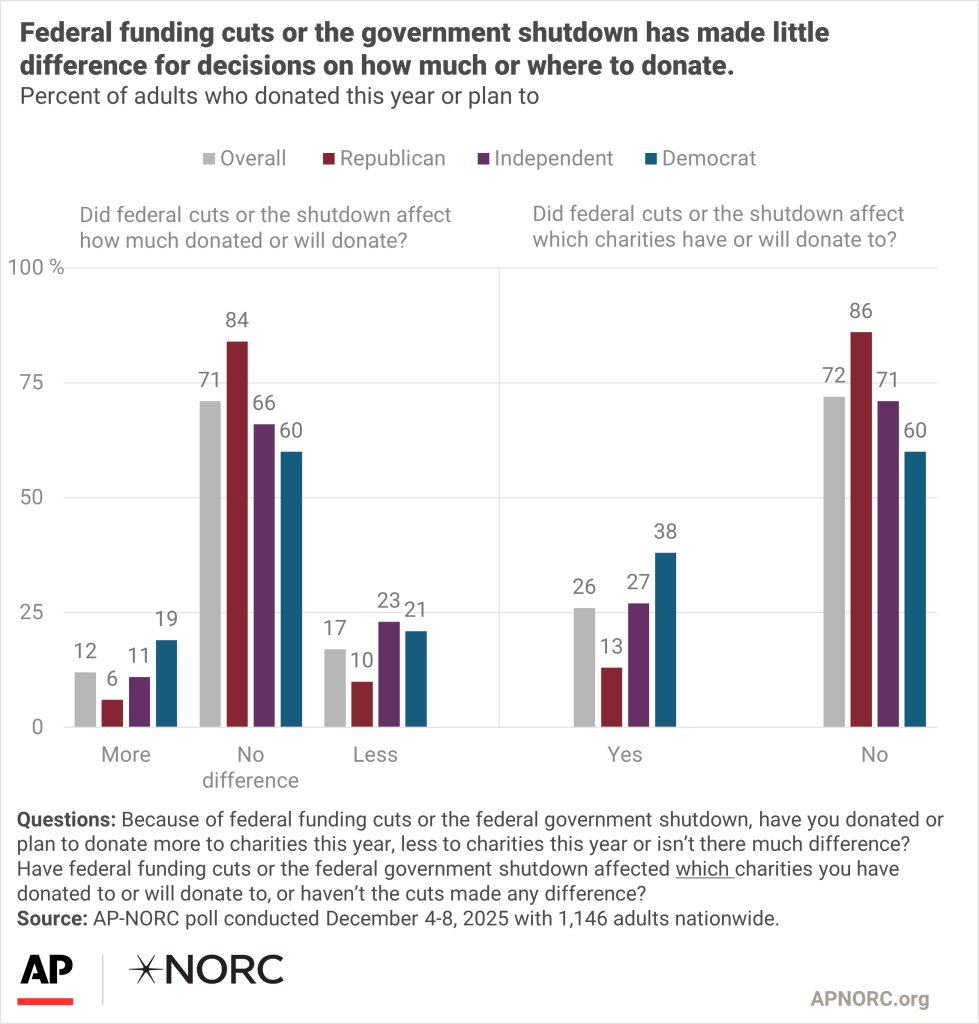
For most adults who have already donated or plan to donate before the end of the year, the federal funding cuts or government shutdown did not affect their giving. About 2 in 10 said these factors made them give less and fewer said it made them give more.
Similarly, 7 in 10 who have given or plan to give soon said that these factors did not influence which charities they donated to. A quarter did make some adjustments. Democrats and independents are more likely than Republicans to have made changes to their giving this year because of federal funding cuts or the government shutdown.
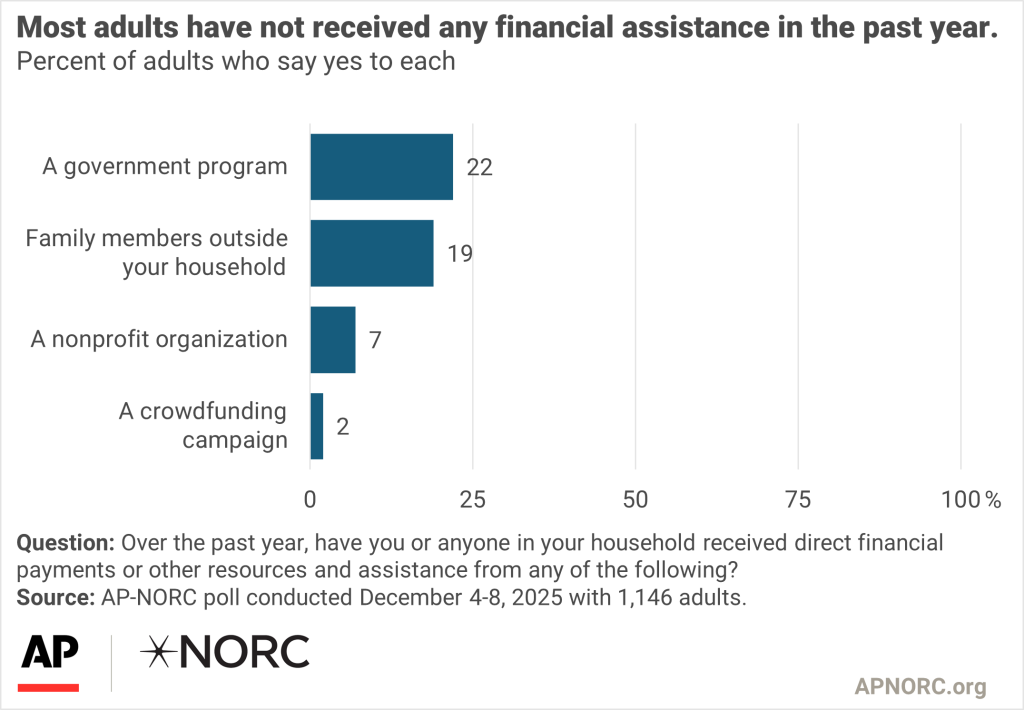
Two in 10 have received assistance from a government program or a family member outside their household. Very few have received assistance from a nonprofit organization or a crowdfunding campaign.
Lower income adults (households making less than $50,000 annually) are more likely than more affluent adults to receive aid from a government program (40% vs. 6%), other family members (25% vs. 10%), or non-profits (10% vs. 4%).
Younger adults are more likely than older adults to be receiving aid from family members outside their household (24% vs. 15%) or from government programs (30% vs. 14%).
The nationwide poll was conducted December 4-8, 2025 using the AmeriSpeak® Panel, the probability-based panel of NORC at the University of Chicago. Online and telephone interviews using landlines and cell phones were conducted with 1,146 adults. The margin of sampling error is +/- 4.0 percentage points.
- Suggested Citation: AP-NORC Center for Public Affairs Research. (December 2025). “Most adults have donated to charities this year.” https://apnorc.org/projects/most-adults-have-donated-to-charities-this-year/