
January 22, 2026
To explore the public’s agenda for the coming year, AAPI Data and The Associated Press-NORC Center for Public Affairs Research conducted a poll in December 2025 in which respondents provided, in their own words, up to five problems that they would like the government to be working on in 2026. Much like the general public, AAPI adults cite economic issues like inflation and the cost of living, immigration, and health care as top priorities for the upcoming year.
The public is not optimistic about the federal government addressing these concerns, with just 10% who are confident the government will make progress on important problems and issues in 2026. Seventy percent are not at all or just slightly confident, up from 60% in a December 2024 AAPI Data/AP-NORC Poll.
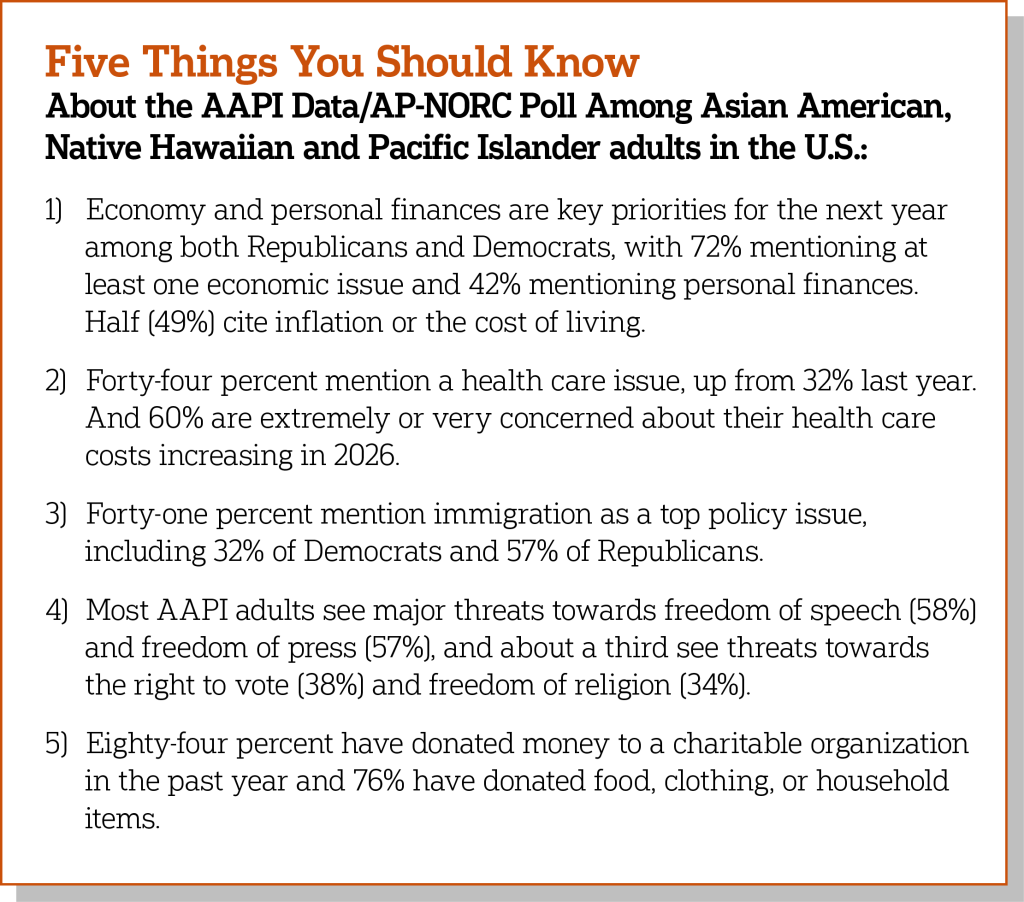
Seventy-two percent of AAPI adults mention at least one economic issue for the government to prioritize in 2026, and another 42% mention an issue related to personal finances. About half of AAPI adults cite inflation or the cost of living as a key priorities (49%), up from 37% last year and higher than the general public (33%). Overall, 6 in 10 think the national economy (58%) will get worse, while about a quarter say they will stay the same. Only 17% say it will get better.
AAPI adults are slightly less pessimistic about their own personal finances, with 45% who say they will stay about the same compared with 35% who say they will get worse. Nineteen percent expect their personal finances to improve.
Health care issues are also top of mind for AAPI communities. Forty-four percent mention a health care issue, up from 32% last year. And 60% are extremely or very concerned about their health care costs increasing, while about 4 in 10 are concerned about not being able to access health care when they need it, not being able to pay for health care, or losing health insurance. These concerns mirror those of the general population.
And while few list democracy as a key issue (6%), AAPI adults express concerns about how democracy is functioning in the United States. More than half say the U.S. is a poorly functioning democracy (57%), while just 21% say it is a well-functioning democracy and 21% say it is not a democracy. And most AAPI adults see major threats towards freedom of speech (58%) and freedom of press (57%). Forty-eight percent think their personal rights and freedoms will get worse in the next year, while 42% say they will stay about the same.
AAPI adults and the general population are in line when it comes to key aspects of the United States’ identity as a nation, with large majorities citing the importance of things like individual liberties and freedoms and a democratically elected government. However, the general population is more likely than AAPI adults to say that a culture grounded in Christian religious beliefs is important (36% vs 21%).
The survey also explores how the AAPI community is giving back this holiday season. Most AAPI adults have donated to those in need in the past year, with about half giving between $1 and $500 dollars. And while AAPI adults and the general population donate similar amounts, AAPI adults are more likely to donate money to a crowdfunding campaign, an organization that provides disaster relief, or an educational institution.
And like the general population, confidence that a charity is impactful (69%) and belief in its cause (69%) are the most important reasons AAPI adults cite for donating. About 3 in 4 say it is very or extremely important to provide charitable assistance to friends or family members, and about half say the same about neighbors or people in their communities. Fewer say the same about people who live elsewhere in the United States (31%) and outside the country (26%).
The nationwide study was conducted by The AP-NORC Center for Public Affairs Research and AAPI Data from December 2-8, 2025, using the Amplify AAPI Monthly Survey drawing from NORC’s Amplify AAPI® Panel designed to be representative of the U.S. Asian American, Native Hawaiian, and Pacific Islander household population. Online interviews were offered in English, the Chinese dialects of Mandarin and Cantonese, Vietnamese, and Korean with 1,029 Asian American, Native Hawaiian, and Pacific Islanders aged 18 and older living in the United States. The margin of sampling error is +/- 4.7 percentage points.