
May 4, 2026
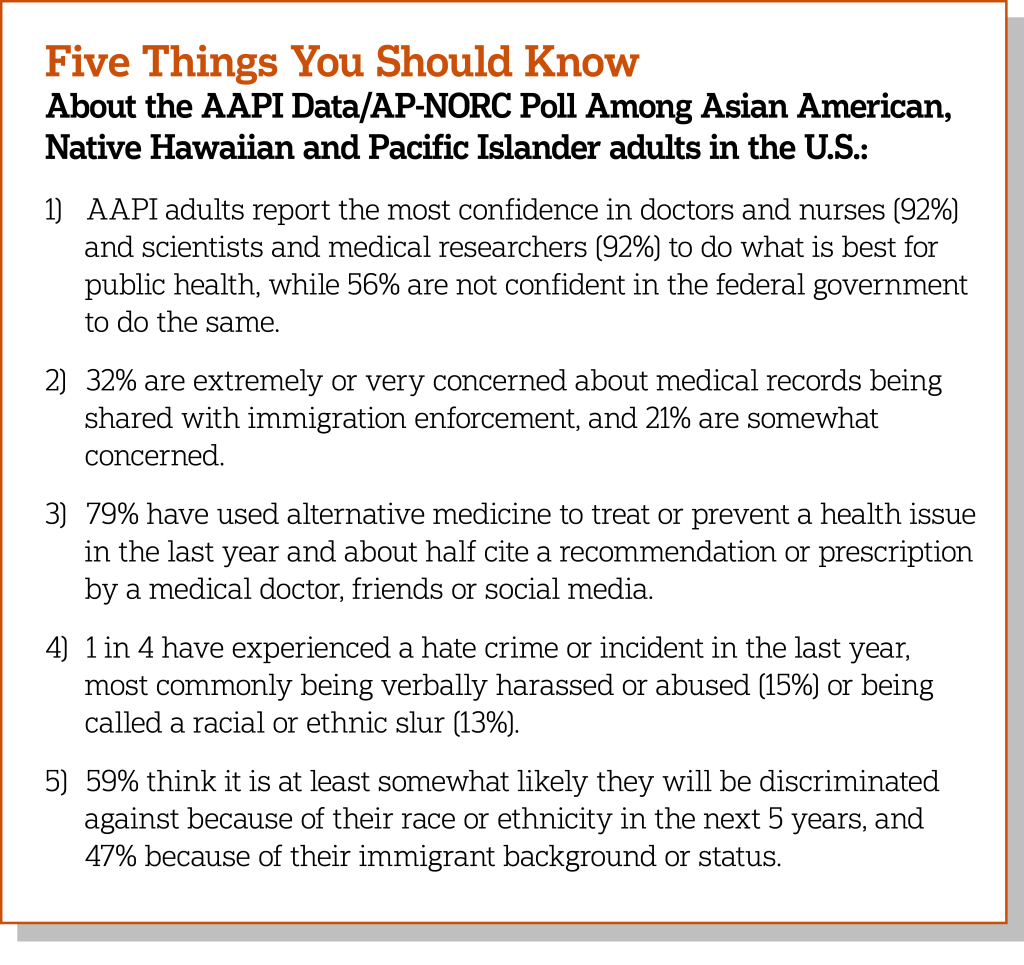
When asked about confidence in medical professionals to act in the best interest of public health, AAPI adults report the most confidence in doctors, nurses, scientists, and medical researchers according to a new AAPI Data/AP-NORC Poll. Nine in 10 express at least some confidence in each of these professions, and about 6 in 10 are extremely or very confident. Fewer express the same level of confidence in alternative medicine practitioners (58%), and more than half (56%) are not confident in the federal government to do what is best for public health.
Trust in various healthcare professions to do what is best for AAPI adults and their families mirrors confidence in doing what is best for public health. They are most likely to trust doctors and nurses (80%), pharmacists (74%), and mental health counselors (58%), as well as public health officials in state government (45%). Fewer trust public health officials in the federal government (27%), alternative medicine practitioners (27%), health insurance providers (22%), or hospital executives (20%). These findings are similar to June 2025.
When it comes to federal health policy, most AAPI adults favor restricting processed foods to remove added sugar or dyes (74%) but are more divided on revising federal dietary guidelines to prioritize meats, dairy and fats (31% favor and 26% oppose). More oppose than favor changes to vaccine policies.
Most AAPI adults have used a form of alternative medicine to treat or prevent health problems in the last year. Seventy-nine percent have used one of the approaches asked about, most commonly dietary supplements (62%) or probiotics (46%). And about half (55%) have used non-dietary approaches, including mindfulness-based stress reduction techniques (32%) or movement practices, such as Yoga, Tai Chi, or Qigong (21%).
Among those who have used one of these approaches, about half cite a recommendation or prescription from a medical doctor (53%), say conventional medicine was too expensive (50%), or received a recommendation through friends or social media (50%). On the other hand, those who have not used any of the alternative medicines asked about cite concerns about effectiveness (40%) and safety (37%), or say their doctor did not recommend them (35%). Thirty-two percent say they were too expensive.
Looking at concerns about health care, about half are extremely or very concerned about not being able to afford treatment options, while about 1 in 3 are concerned about treatments not being taken seriously by providers or medical records being shared with immigration enforcement. Fewer are concerned about not having access to language services (11%).
The survey also covers mental health topics and finds that 3 in 4 AAPI adults cite personal finances (75%) and health concerns (74%) as a major or minor source of stress, while 59% say the same about relationships with friends or family.
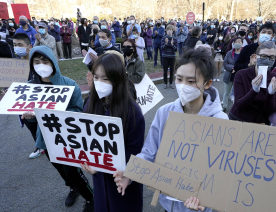
And while discrimination is a source of stress for fewer AAPI adults than other issues, 48% still say it is a source of stress in their life right now including 11% who say it is a major source. One in 10 have experienced a hate crime in the last year, and another 2 in 10 have experienced a hate incident. These findings are similar to reports among AAPI adults in June 2025, and mark a decline compared with October 2023.
Few AAPI adults experience discrimination very often, but most have experienced it at some point in their community (64%) or when applying for jobs (60%), and about half have experienced it when getting health care from doctors (51%) or dealing with the police (53%). About 6 in 10 AAPI adults think it is likely they will face discrimination because of their race or ethnicity in the next 5 years, including 29% who say it is extremely or very likely, and about half say the same about their immigrant background or status.
And while most AAPI adults do not feel symptoms of anxiety, those who experienced a hate crime or incident are more likely than those who did not to experience moderate or severe anxiety (28% vs 14%), as are those who cite health concerns, personal finances, personal relationships, or discrimination as stressors in their lives.
The nationwide study was conducted by The AP-NORC Center for Public Affairs Research and AAPI Data from March 23-30, 2026, using the Amplify AAPI Monthly Survey drawing from NORC’s Amplify AAPI® Panel designed to be representative of the U.S. Asian American, Native Hawaiian, and Pacific Islander household population. Online interviews were offered in English, the Chinese dialects of Mandarin and Cantonese, Vietnamese, and Korean with 1,228 Asian American, Native Hawaiian, and Pacific Islanders aged 18 and older living in the United States. The margin of sampling error is +/- 4.5 percentage points.