

May 6, 2026
After months of increased immigration enforcement across the country, few Americans view the United States as a great place for immigrants today, though they believe it once was. About a quarter say that concerns about immigration status have impacted daily life for them or someone they know in the past year. And as the Supreme Court considers potential limits on birthright citizenship, the public expresses nuanced views about which children born in the U.S. should be granted automatic citizenship.
Sixty-one percent say the U.S. used to be a great place for immigrants but is not anymore, and only 27% feel the country is currently a great place for immigrants. Ten percent say the U.S. was never a great place for immigrants.
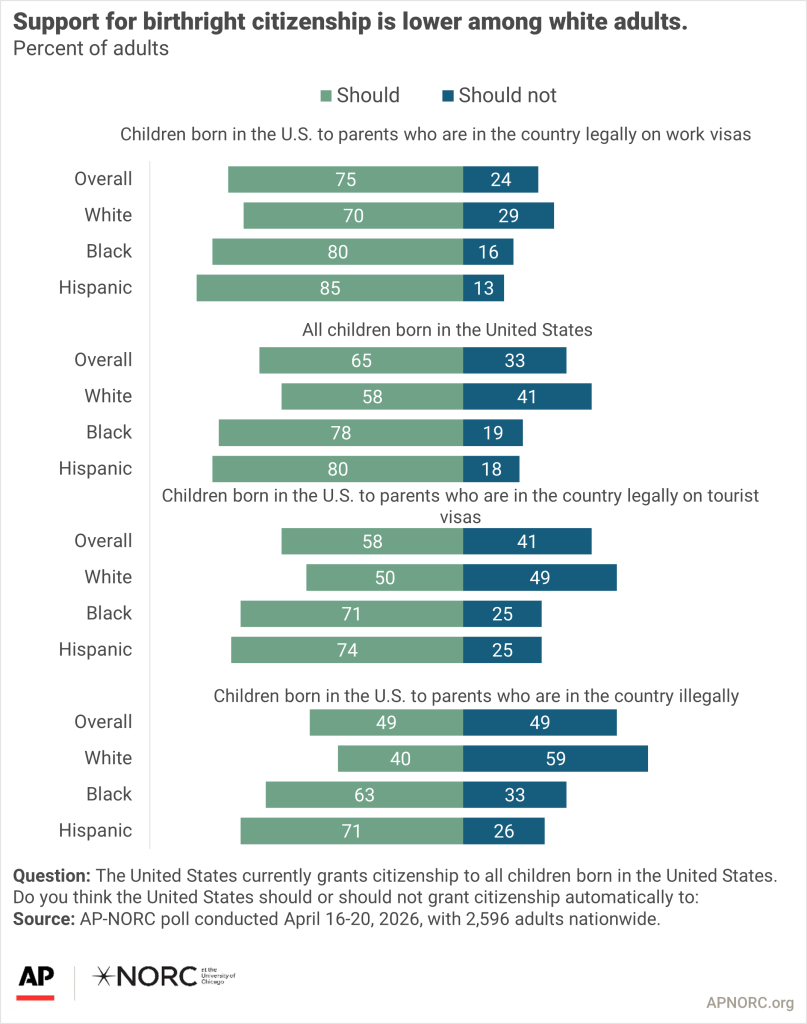
Sixty-five percent feel that citizenship should be granted to all children born on American soil, no matter the circumstances. But support for birthright citizenship varies based on the situation. Three-quarters believe that children born in the U.S. whose parents who are in the country legally on work visas should be automatically granted citizenship. Fewer, though still more than half (58%), think children born in the U.S. whose parents are in the country legally on tourist visas should automatically be citizens. The public is evenly split regarding birthright citizenship for children whose parents are in the country illegally.
Over the past year, a quarter of adults say they have started carrying proof of their citizenship or immigration status or know someone who has. Two in 10 have either adjusted travel plans or significantly altered their daily routines, or know someone who has, because of their immigration status.
Read more here
The nationwide poll was conducted April 16-20, 2026 using the AmeriSpeak® Panel, the probability-based panel of NORC at the University of Chicago. Online and telephone interviews using landlines and cell phones were conducted with 2,596 adults. The overall margin of sampling error is +/- 2.6 percentage points.
- Suggested Citation: AP-NORC Center for Public Affairs Research. “Only a quarter believe that the U.S. is a great place for immigrants” (April 2026). https://apnorc.org/projects/only-a-quarter-believe-that-the-u-s-is-a-great-place-for-immigrants/