

June 25, 2026
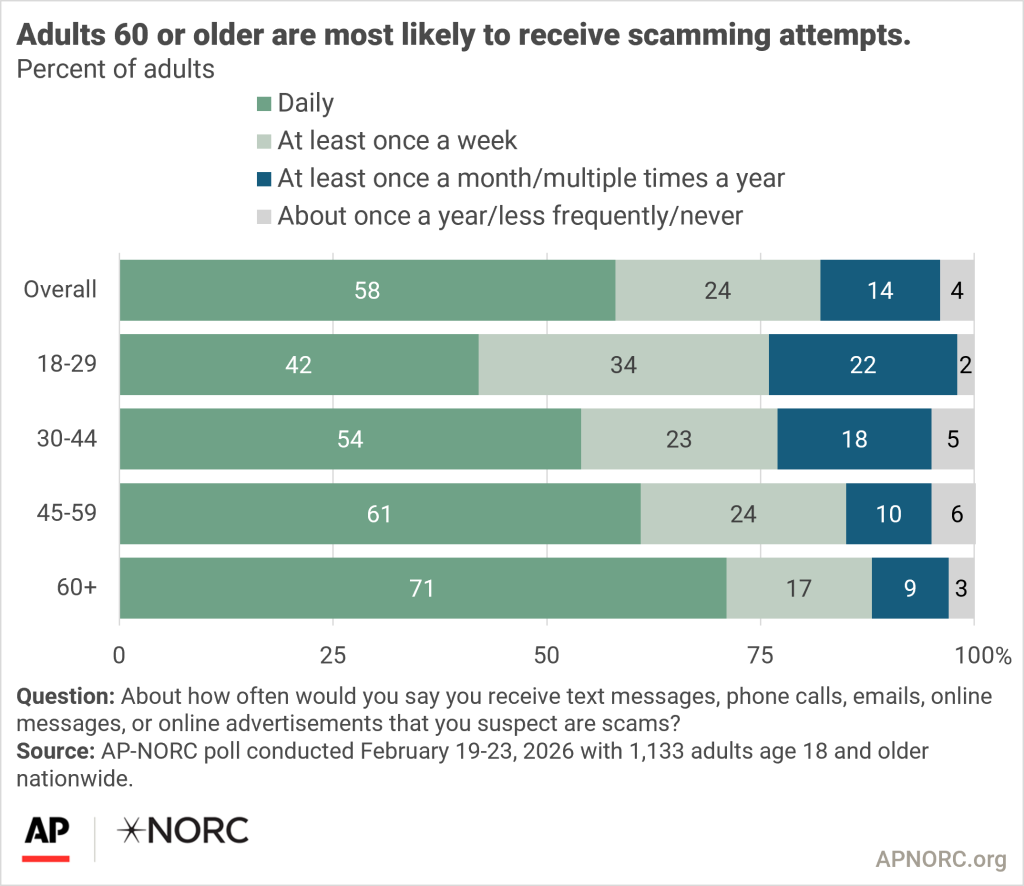
As financial losses from cyberscams surge in the U.S., 58% of the public say they receive daily texts, calls, emails, or online messages or advertisements they suspect are scams. Ninety-two percent of adults encounter scamming attempts at least once a month.
Adults 60 or older are more likely than younger adults to experience scamming attempts on a daily basis.
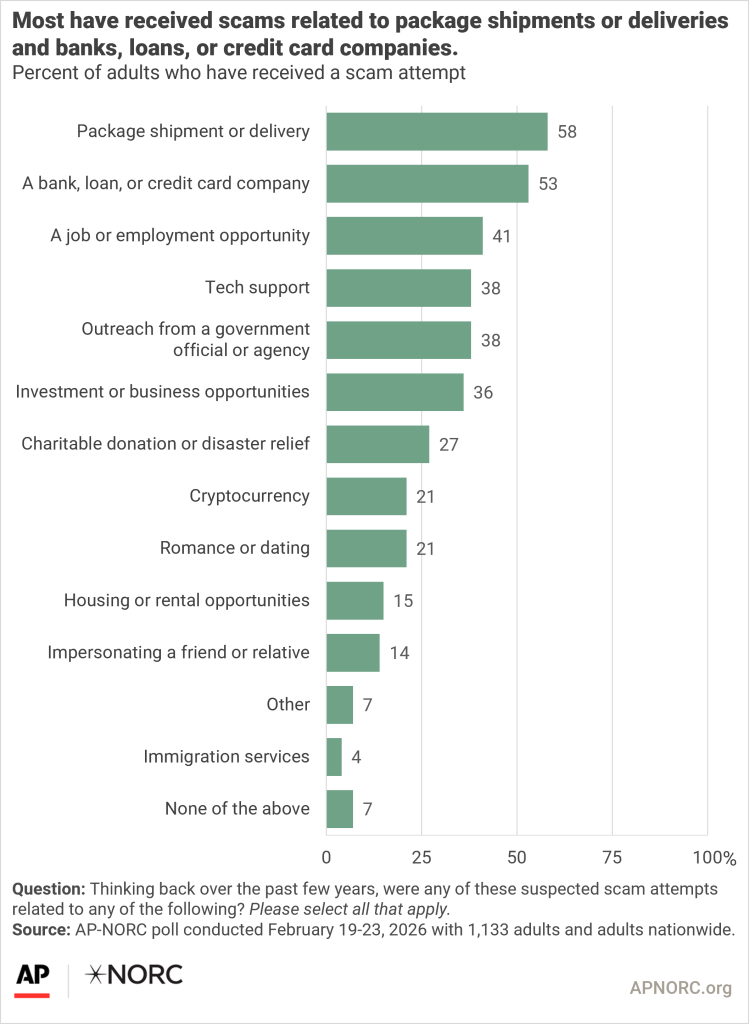
Among those experiencing scam attempts, the most common types are related to package deliveries and banks, loans, or credit cards.
Adults 60 or older exposed to scam attempts are more likely than those younger than 30 to say to the scams involved tech support (50% vs. 30%), an investment or business opportunity (43% vs. 28%), a charitable donation or disaster relief (41% vs. 14%), or impersonations of a friend or relative (21% vs. 6%).
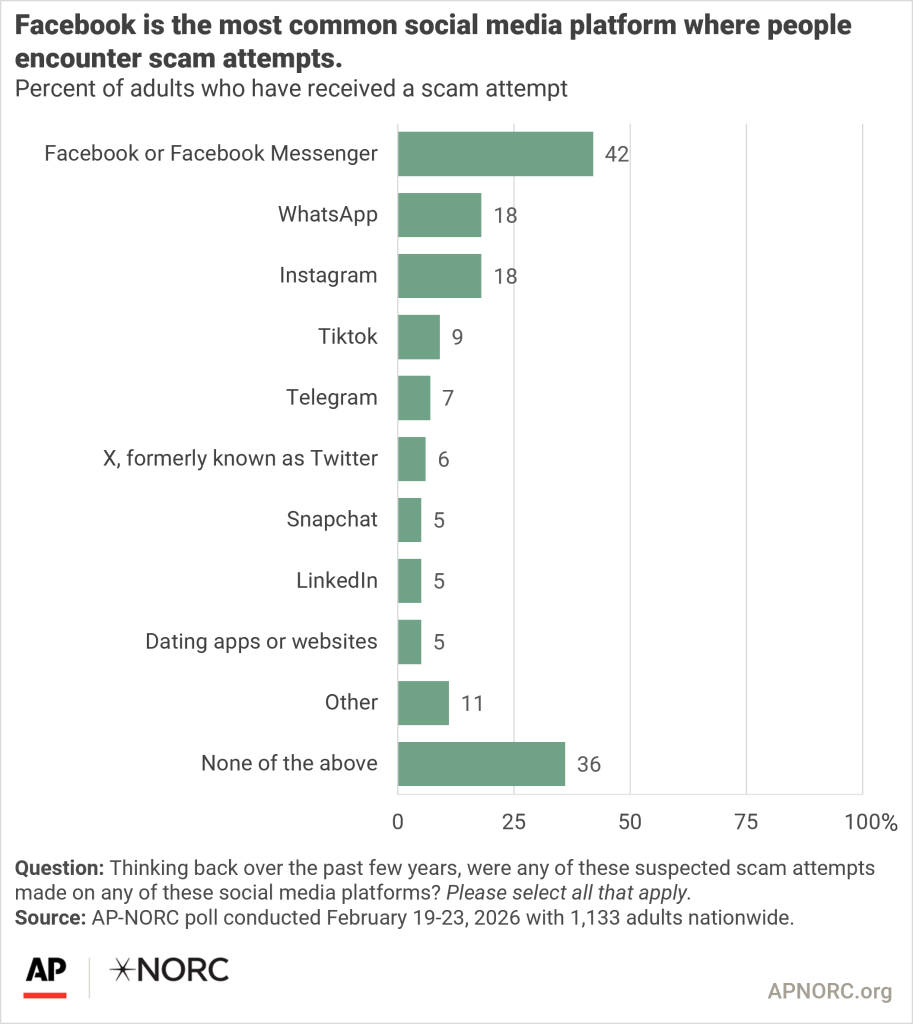
More people who report scam attempts see them on Facebook than on any other social media platform.
Adults under 30 exposed to scam attempts encounter them on Instagram more often than those 60 and older (27% vs. 12%), while older adults see more scams on Facebook (49% vs. 25%).
A quarter of all adults (24%) say they have been scammed into providing personal information. While few say they have personally been scammed into giving away money (17%), half of the public (51%) know someone who has.
Among those who say they have been scammed, most reported it to their bank or credit card company (58%), while half went to the online platform where they were contacted (45%). Few say they reported it to local or state authorities (28%) or federal law enforcement (15%).
The public views online scam prevention as a shared responsibility. Sixty-five percent say banks or credit card companies have a great deal or quite a lot of responsibility to block online scams. Social media companies (58%), the federal government (54%), and individuals themselves (57%) are also seen as being responsible for stopping online scams.
Adults 60 or older are more likely than adults younger than 30 to expect bank or credit card companies (77% vs. 55%), social media companies (67% vs. 52%), and the federal government (67% vs. 50%), to block online scams.
Read more here
The nationwide poll was conducted February 19-23, 2026 using the AmeriSpeak® Panel, the probability-based panel of NORC at the University of Chicago. Online and telephone interviews using landlines and cell phones were conducted with 1,133 adults. The overall margin of sampling error is +/- 4.0 percentage points.
- Suggested Citation: AP-NORC Center for Public Affairs Research. “Older adults are the most likely to receive daily scam attempts” (February 2026). https://apnorc.org/projects/fifty-eight-percent-of-adults-report-receiving-scam-attempts-daily/