
News
Vadim Volos
Vadim Volos is a vice president in the Public Affairs and Media Research department at NORC. Volos supports NORC’s research on public opinion and elections, survey methodology, and media attitudes. He guides and manages survey research on topics dealing with public affairs and helps present complex issues to a wide variety of audiences.
In his role, Vadim brings over 25 years of experience in public affairs and public opinion research. He has extensive experience directing work for non-Federal clients, including academic, non-profit, public relations firms, and media and technology companies, both in the U.S. and internationally. Vadim joins NORC from Ipsos, where he was a senior vice president and was previously part of GfK that was acquired by Ipsos; both firms are global market research and public opinion companies with whom NORC has collaborated in the past. While at GfK, Vadim worked with the AP-NORC Center to manage the field work for our projects in Cuba and Russia.
AP-NORC poll: Most say restrict abortion after 1st trimester
By David Crary and Hannah Fingerhut | The Associated Press
June 25, 2021
NEW YORK (AP) — A solid majority of Americans believe most abortions should be legal in the first three months of a woman’s pregnancy, but most say the procedure should usually be illegal in the second and third trimesters, according to a new poll.
The poll comes just weeks after the U.S. Supreme Court agreed to hear a case involving a currently blocked Mississippi law that would ban abortions after 15 weeks of pregnancy, two weeks into the second trimester. If the high court upholds the law, it would be the first time since the 1973 Roe v. Wade decision confirming a woman’s right to abortion that a state would be allowed to ban abortions before a fetus can survive outside the womb.
The new poll from The Associated Press-NORC Center for Public Affairs Research finds 61% of Americans say abortion should be legal in most or all circumstances in the first trimester of a pregnancy. However, 65% said abortion should usually be illegal in the second trimester, and 80% said that about the third trimester.
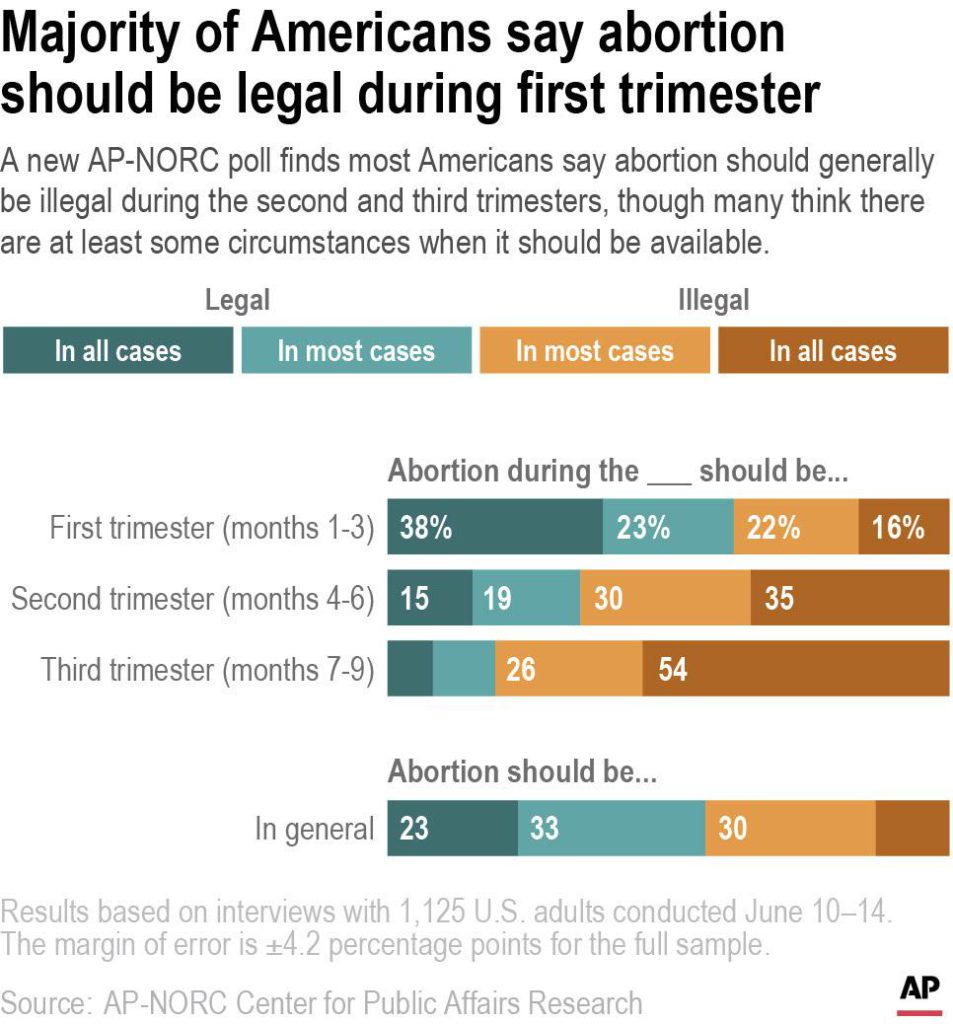
Still, the poll finds many Americans believe that the procedure should be allowable under at least some circumstances even during the second or third trimesters. For abortions during the second trimester, 34% say they should usually or always be legal, and another 30% say they should be illegal in most but not all cases. In the third trimester, 19% think most or all abortions should be legal, and another 26% say they should be illegal only in most cases.
Michael New, an abortion opponent who teaches social research at Catholic University of America, predicted the findings regarding second- and third-trimester abortions will be useful to the anti-abortion movement.
“This helps counter the narrative that the abortion policy outcome established by the Roe v. Wade decision enjoys substantial public support,” he said.
David O’Steen, executive director of the National Right to Life Committee, said the findings suggest that abortion rights advocates are “way out of the public mainstream” to the extent that they support abortion access even late in pregnancy.
But Dr. Daniel Grossman, a professor of obstetrics and gynecology at the University of California, San Francisco, who supports abortion rights, cited research showing that Americans viewed second-trimester abortions more empathetically when told about some of the reasons why women seek them.
These include time-consuming difficulties making arrangements with an abortion clinic and learning during the second trimester that the fetus would die or have severe disabilities due to abnormalities, Grossman said.
“More work needs to be done to elevate the voices of people who have had abortions and who want to share their stories to help people understand the many reasons why this medical care is so necessary,” he said via email.
Majorities of Americans — Republicans and Democrats alike — think a pregnant woman should be able to obtain a legal abortion if her life is seriously endangered, if the pregnancy results from rape or incest or if the child would be born with a life-threatening illness.
Americans are closely divided over whether a pregnant woman should be able to obtain a legal abortion if she wants one for any reason, 49% yes to 50% no.
Jenny Ma, senior staff attorney with the Center for Reproductive Rights, said women seeking second-trimester abortions included disproportionately high numbers of young people, Black women and women living in poverty. Some had not learned they were pregnant until much later than the norm; others had trouble raising the needed funds to afford an abortion, Ma said.
She noted that Republican-governed states have enacted numerous restrictions in recent years that often complicated the process for getting even a first-trimester abortion.
“Removing the many existing barriers to earlier abortion care would reduce need for second- and third-trimester abortions,” Ma said.
Abortions after the first trimester are not rare, but they are exceptions to the norm. The Centers for Disease Control and Prevention, in its most recent report on abortion in the U.S., estimated that 92% of the abortions in 2018 were performed within the first 13 weeks of pregnancy.
The poll also shows how opinions on abortion diverge sharply along party lines. Roughly three-quarters of Democrats think abortion should be legal in all or most cases; about two-thirds of Republicans think it should be illegal in all or most cases.
But most Americans fall between extreme opinions on the issue. Just 23% say abortion in general should be legal in all cases, while 33% say it should be legal in most cases. Thirty percent say abortion should be illegal in most cases; just 13% say it should be illegal in all cases.
Respondents from three major religious groups — white mainline Protestants, nonwhite Protestants and Catholics — are closely divided as to whether abortion should usually be legal or illegal in most cases. It was different for white evangelicals — about three-quarters of them say abortion should be illegal in all or most cases.
Dave Steiner, a hotel manager from suburban Chicago, was among those responding to the AP-NORC poll who said abortion should be legal in the first trimester but generally illegal thereafter.
“I was raised a very strict Catholic — abortion was just no, no, no,” said Steiner, 67. “As I became more liberal and a Democrat, I felt the woman should have the right to choose — but that should be in the first trimester.”
“Abortions are going to happen anyway,” he added. “If you’re making it illegal, you’re just chasing it underground.”
Fingerhut reported from Washington. Associated Press video journalist Hilary Powell in Washington contributed to this report.
The AP-NORC poll of 1,125 adults used a sample drawn from NORC’s probability-based AmeriSpeak Panel, which is designed to be representative of the U.S. population. The margin of sampling error for all respondents is plus or minus 4.2 percentage points.
AP-NORC poll: Parties split on some infrastructure proposals
By Josh Boak and Hannah Fingerhut | The Associated Press
July 22, 2021
WASHINGTON (AP) — The overwhelming majority of Americans — about 8 in 10 — favor plans to increase funding for roads, bridges and ports and for pipes that supply drinking water. But that’s about as far as Democrats and Republicans intersect on infrastructure, according to a new poll from The Associated Press-NORC Center for Public Affairs Research.
President Joe Biden has bet that his handshake with a group of Republican senators can help power a $973 billion infrastructure deal through Congress, while Democrats would separately take up a $3.5 trillion proposal that could include money for child tax credits, schools, health care and other priorities. The dual-track approach has produced plenty of drama and uncertainty in Washington as negotiations continue, and those divisions seem to extend to the public at large.
The poll finds a slim majority of Americans, 55%, approve of Biden’s handling of infrastructure; 42% disapprove. About 8 in 10 Democrats, but just 2 in 10 Republicans, approve of Biden on infrastructure.
“I like what he’s done so far,” said Marcos Ommati, 54, who lives in Arlington, Virginia, and edits a military magazine. “The infrastructure plan that he put out there, I think we need that desperately. If you drive around any places in the U.S., you see that the bridges are not in top shape.”
After the $1.9 trillion coronavirus relief package jumpstarted the economy — possibly creating the risk of inflation — the administration trusts that many voters will cast their ballots in next year’s election on infrastructure and other spending initiatives aimed at helping the economy.
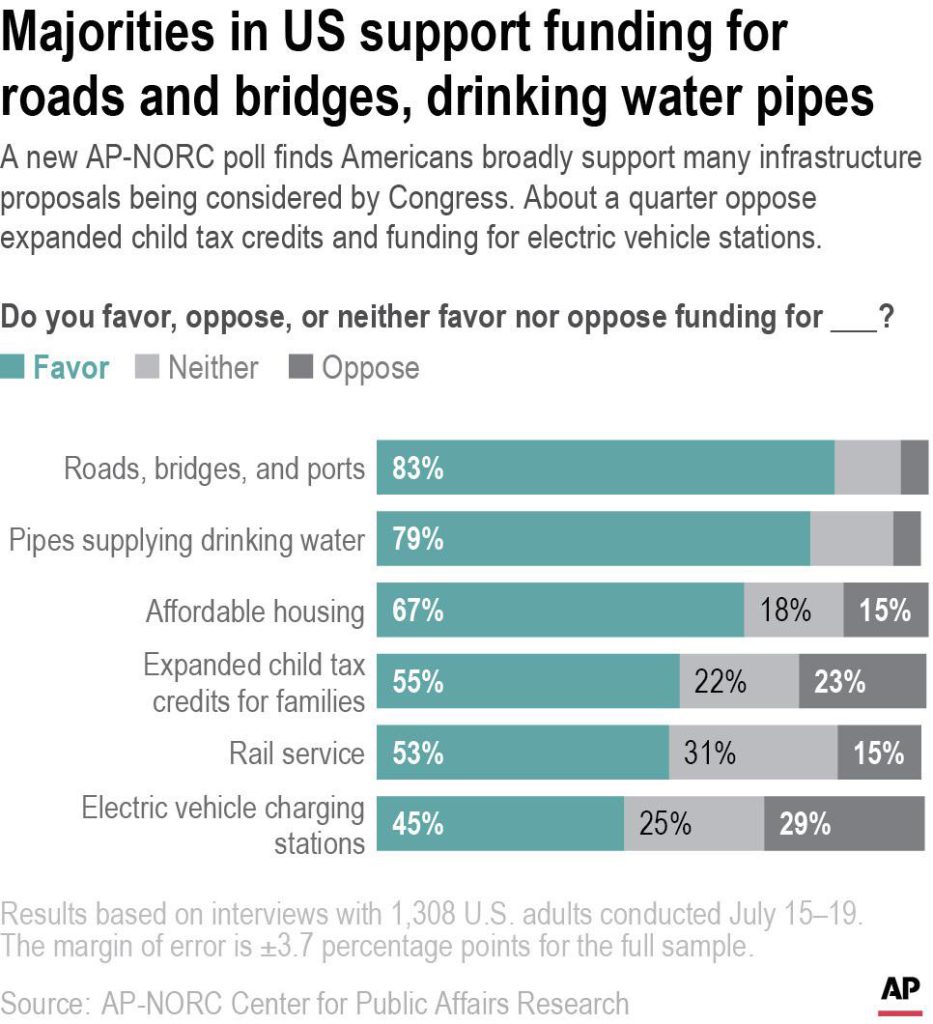
There is general support for strengthening the electric grid, which has been battered this year by a deep freeze in Texas and extreme weather in recent months across the rest of the country. Many of the other infrastructure ideas championed by Biden splinter along party lines, with Republicans largely expressing uncertainty or opposition about many proposals.
Overall, at least 6 in 10 Americans back funding for local public transit, for affordable housing and for broadband internet service. While strong majorities of Democrats are in favor, fewer than half of Republicans back any of the three.
About two-thirds of Democrats also support funding for passenger and rail service, compared with about 4 in 10 Republicans. Among Republicans, roughly a quarter say they are opposed and about a third say they hold neither opinion.
Fewer than half of Americans, 45%, back funding for electric vehicle charging stations, while 29% are opposed. About two-thirds of Democrats, but only about a quarter of Republicans, are in favor. Roughly half of Republicans are opposed.
Slim majorities back expanded child tax credits for families with children and free community college for those who have not yet been to college. About three-quarters of Democrats favor both proposals.
Only about a quarter of Republicans support free community college, while about 6 in 10 are opposed. Republican views are more mixed on the expanded child tax credit: 34% are in favor, while 42% are opposed; another 24% say they hold neither opinion.
Support is generally stronger for funding for free preschool programs, with about two-thirds in support, including about 8 in 10 Democrats and about half of Republicans. Three in 10 Republicans are opposed.
But those investments in children and preschool strike voters like Alan Gioannetti as distortions of the idea of infrastructure. He equates the concept with anything that involves the work of engineers.
“If I need the foundation on my house repaired, I’m not going to call a social worker — I’ll call an engineer,” said Gioannetti, 69, who retired from the oil and gas business and lives in Seabrook, Texas. He takes a similarly dim view on Biden: “Being in the energy business, this new clown we have for a president screwed everything up for my friends and family.”
To pay for infrastructure improvements, about two-thirds of Americans support raising taxes on corporations and raising taxes on households earning more than $400,000 annually. But again, there is a divide on taxes as many Republicans lawmakers believe the increases would hurt economic growth.
At least 8 in 10 Democrats, but about 4 in 10 Republicans, support raising taxes on corporations or households earning over $400,000 annually. Close to 4 in 10 Republicans oppose both.
The tax issue is as much about fairness as many Americans see the existing rules as enabling billionaires such as the founder of Amazon, Jeff Bezos, to pay at lower rates than people in the middle class.
“The tax system has allowed people to take advantage of their wealth, and I pay more taxes,” said Amy Stauffer, of Hesston, Kansas, who voted for Biden. “I pay more taxes than Jeff Bezos. Something’s wrong with that.”
The AP-NORC poll of 1,308 adults was conducted July 15-19 using a sample drawn from NORC’s probability-based AmeriSpeak Panel, which is designed to be representative of the U.S. population. The margin of sampling error for all respondents is plus or minus 3.7 percentage points.
AP-NORC poll: Most unvaccinated Americans don’t want shots
By Tammy Webber and Emily Swanson | The Associated Press
July 23, 2021
Most Americans who haven’t been vaccinated against COVID-19 say they are unlikely to get the shots and doubt they would work against the aggressive delta variant despite evidence they do, according to a new poll that underscores the challenges facing public health officials amid soaring infections in some states.
Among American adults who have not yet received a vaccine, 35% say they probably will not, and 45% say they definitely will not, according to a poll from The Associated Press-NORC Center for Public Affairs Research. Just 3% say they definitely will get the shots, though another 16% say they probably will.
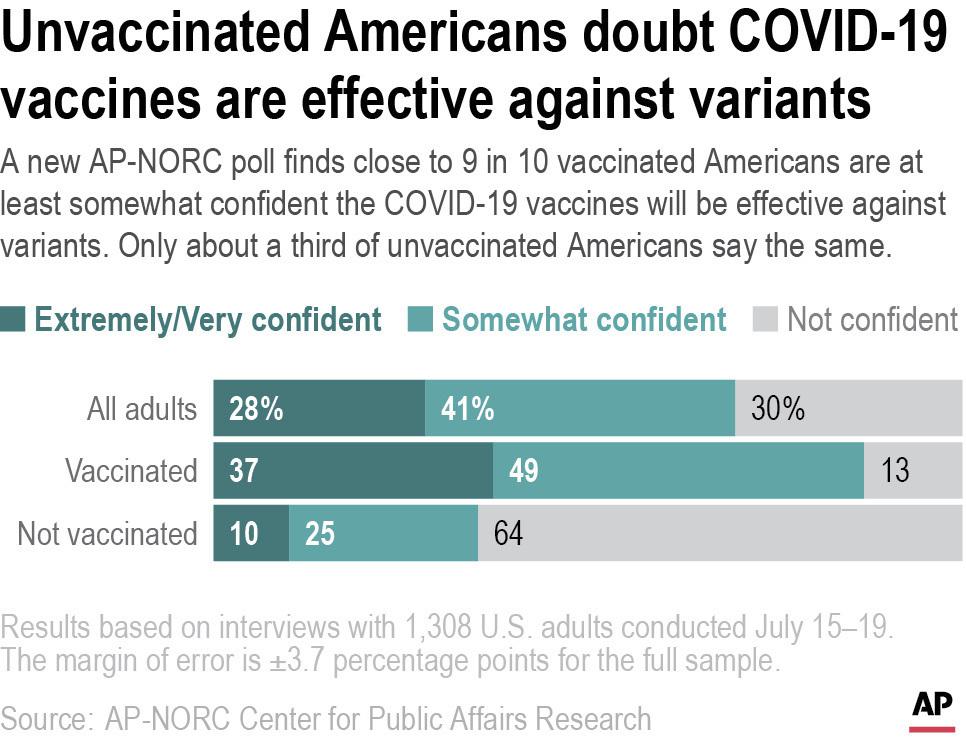
What’s more, 64% of unvaccinated Americans have little to no confidence the shots are effective against variants — including the delta variant that officials say is responsible for 83% of new cases in the U.S. — despite evidence that they offer strong protection. In contrast, 86% of those who have already been vaccinated have at least some confidence that the vaccines will work.
That means “that there will be more preventable cases, more preventable hospitalizations and more preventable deaths,” said Dr. Amesh Adalja, an infectious disease specialist at Johns Hopkins University.
“We always knew some proportion of the population would be difficult to persuade no matter what the data showed, (and) a lot of people are beyond persuasion,” Adalja said. He echoed Centers for Disease Control and Prevention Director Rochelle Walensky in calling the current surge “a pandemic of the unvaccinated” because nearly all hospital admissions and deaths have been among those who weren’t immunized.
The AP-NORC survey was conducted before several Republicans and conservative cable news personalities this week urged people to get vaccinated after months of stoking hesitancy. That effort comes as COVID-19 cases nearly tripled in the U.S. over the past two weeks.
Nationally, 56.4% of all Americans, including children, have received at least one dose of the vaccine, according to the CDC. And White House officials said Thursday that vaccinations are beginning to increase in some states where rates are lagging behind and COVID-19 cases are rising, including in Arkansas, Florida, Louisiana, Missouri and Nevada.
Still, just over 40% of Louisiana’s population has received at least one dose, and the state reported 5,388 new COVID-19 cases Wednesday — the third-highest single-day figure since the pandemic began. Hospitalizations also rose steeply in the last month.
The AP-NORC survey found that the majority of Americans — 54% — are at least somewhat concerned that they or someone in their family will be infected, including 27% who are very concerned. That’s up slightly from a month ago, but far below the beginning of the year, when about 7 in 10 Americans said they were at least somewhat concerned that they or someone they knew would be infected.
Democrats are far more likely than Republicans to say they’re at least somewhat concerned about someone close to them being infected, 70% to 38%.
And overall, Republicans are far more likely than Democrats to say they have not been vaccinated and definitely or probably won’t be, 43% to 10%. Views are also divided along age and education lines: Thirty-seven percent of those under age 45 say they haven’t and likely won’t get the shots, compared with just 16% of those older. And those without college degrees are more likely than those with them to say they aren’t and won’t be vaccinated, 30% to 18%.
Cody Johansen, who lives near Orlando, Florida, considers himself a conservative Republican, but said that had no bearing on his decision to skip vaccination.
“It hasn’t really been that dangerous to people in my demographic, and I have a good immune system,” said Johansen, a 26-year-old who installs audio-visual equipment at military bases. “Most of my friends got vaccinated, and they’re a little mad at me for not getting it. There is peer pressure because they say it’s a civic responsibility.”
He said it’s obvious the shots have been effective, though it bothers him a little that they have only emergency use authorization from the Food and Drug Administration.
Johansen said he approves of how President Joe Biden has handled the pandemic response, saying he has exhibited good leadership.
That reflects the poll’s findings. A large majority of Americans, 66%, continue to approve of how Biden is handling the pandemic — higher than Biden’s overall approval rating of 59%.
The difference is fueled largely by Republicans, 32% of whom say they approve of Biden’s handling of COVID-19 compared with 15% who approve of him overall. About 9 in 10 Democrats approve of Biden overall and for his handling of the pandemic.
On Friday, White House press secretary Jen Psaki told reporters that the Biden administration has persuaded “a whole lot of people to change their minds and take action, get a shot, save their lives and the lives of people around them.” She noted that more than 5.2 million have received shots in the past 10 days, and said officials would continue their outreach efforts.
Jessie McMasters, an aerospace engineer who lives near Rockford, Illinois, said she got her first shot when she was 37 weeks’ pregnant after talking with her midwife and reading about how the Pfizer and Moderna vaccines were developed.
“That gave me high confidence that they worked,” McMasters said. Her parents both were infected but did not suffer serious illness, and both have since been vaccinated.
She said her friends and family are all over the place when it comes to their views on vaccination and other virus-prevention measures — often reflecting how such discussions have become partisan. Some who got it are “so far on one end that they may never give up masks because now it’s a personal statement,” said McMasters, who leans Democratic, just as others won’t get the shots because of their political beliefs or misinformation.
Dr. Howard Koh, a professor at the Harvard Chan School of Public Health, said vaccine hesitancy is not new, but the misinformation surrounding COVID-19 and the fast-spreading variant make it imperative to reach people one-on-one to understand their concerns and provide accurate information.
He called the new surge in infections and deaths “just heartbreaking.”
“What I learned from my patients is that when a loved one dies, that’s a tragedy,” said Koh, who was a senior public health official in the Obama administration. “But when a loved one dies and you know it could have been prevented, that tragedy haunts you forever.”
Webber reported from Fenton, Michigan. Swanson reported from Washington. AP White House reporters Josh Boak and Aamer Madhani contributed to this story.
The AP-NORC poll of 1,308 adults was conducted July 15-19 using a sample drawn from NORC’s probability-based AmeriSpeak Panel, which is designed to be representative of the U.S. population. The margin of sampling error for all respondents is plus or minus 3.7 percentage points.