
March 23, 2026
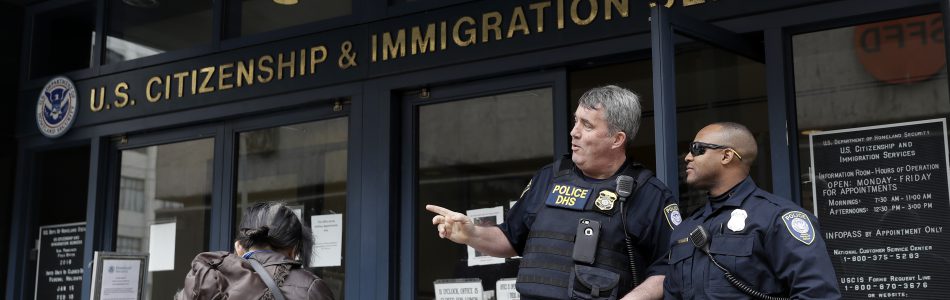
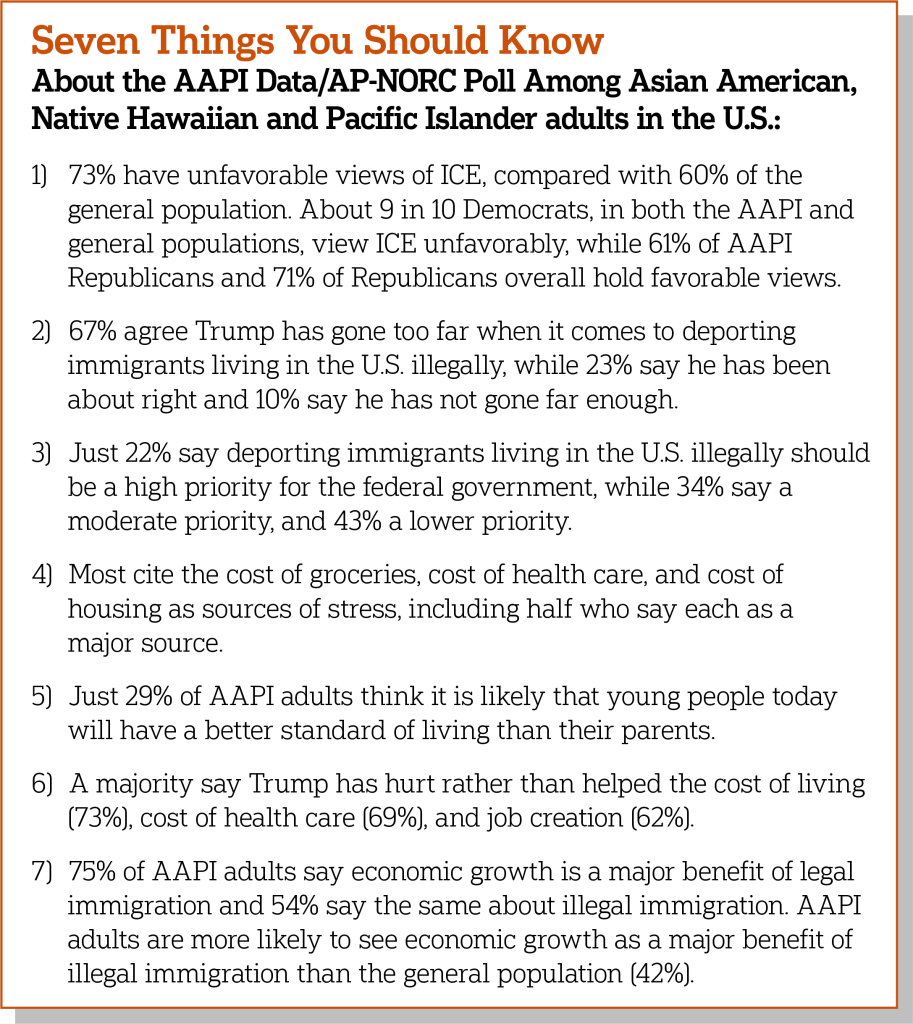
Seventy-three percent of AAPI adults have unfavorable views of U.S. Immigration Custom and Enforcement (ICE), compared with 60% of the general population, according to a new AAPI Data/AP-NORC Poll. Among both AAPI adults and the general population, about 9 in 10 Democrats view ICE unfavorably, while 61% of AAPI Republicans and 71% of Republicans overall hold favorable views. These findings come in the midst of mass deportation efforts across the country, including highly publicized cases of ICE detaining U.S. citizens.
Overall, AAPI adults see both benefits and risks to immigration. American companies getting the expertise of skilled workers, enriching American culture and values, contributing to economic growth, and taking jobs that Americans don’t want are considered major or minor benefits of legal immigration by a majority of AAPI adults. AAPI adults are significantly more likely to view each as a major benefit compared with the general population. Many also see major economic benefits when immigrants come to the United States illegally, by taking jobs Americans don’t want (58%) or contributing to economic growth (54%).
And while few AAPI adults see major risks to legal immigration, about half see minor risks from increasing burdens on welfare or safety net programs or limiting the job market, and about 6 in 10 when it comes to crime. Fewer, about half, are concerned that immigrants will vote illegally in U.S. elections. The general population is more likely to consider voting illegally a risk than AAPI adults.
Sixty-one percent of AAPI adults say Trump has hurt rather than helped immigration and border security, and most agree he has gone too far when it comes to deporting immigrants living in the U.S. illegally (67%) or putting new restrictions on who can enter the country legally (63%).
Just 22% say deporting immigrants living in the U.S. illegally should be a high priority for the federal government, while 34% say it should be a moderate priority, and 43% consider it a lower priority. About a quarter say allowing refugees to come to the U.S. to escape violence should be a high priority (26%). However, just 9% say allowing white South Africans (Afrikaners) to escape threats or persecution due to their race or political beliefs should be a high priority, despite a Trump-administration program fast-tracking the relocation of this group.
Thirty-one percent of AAPI adults say increasing security at the U.S.-Mexico border should be a high priority and another 38% say it should be a moderate priority. This is lower than a recent poll among the general population (45%), and lower than it was among AAPI adults a year ago (42%). Just 9% of AAPI Democrats say this is a high priority, compared with 25% of Democrats overall. Republicans and independents are more supportive and hold similar views across both populations.
Looking at visa policies, 22% say deporting immigrants who overstay their visas should be a high priority, and 37% say it should be a moderate one. AAPI adults are more concerned with overstayed visas when they have committed a crime (66% high priority and 21% moderate). Fewer prioritize banning all immigration from countries with a history of immigrants overstaying their visas, or deporting immigrants who overstay their visas and are married to U.S. citizens.
Echoing findings from September 2025, most oppose current immigration enforcement policies including allowing agents to cover their faces when arresting people (70%), using the military and national guard to detain and deport immigrants who are in the country illegally (61%), conducting large-scale sweeps in immigrant neighborhoods (60%), and arresting immigrants who are in the country illegally while they are at their job (60%).
When it comes to the economy, the cost of living is a key concern for AAPI adults. Most AAPI adults say their financial situation is holding steady (64%), but a vast majority cite the cost of groceries, cost of health care, and cost of housing as sources of stress, including half who say each as a major source. Similar to findings from the April AAPI Data/AP-NORC Poll, few are very confident they can keep up with their expenses (25%), could pay an unexpected medical expense (21%), will have enough savings for retirement (21%), or could find a good job if they wanted to (15%). Just 29% of AAPI adults think it is likely that young people today will have a better standard of living than their parents.
Few think that Trump’s policies have helped their economic concerns. A majority say that he has hurt the cost of living (73%), cost of health care (69%), and job creation (62%), and 76% say his tariffs on other countries have gone too far.
Overall, AAPI adults have an unfavorable view of Trump (72%), and many key officials in his administration including J.D. Vance (65%), Robert F. Kennedy Jr. (59%), and Marco Rubio (55%). Sixty-eight percent have unfavorable view of the Republican party. These are more negative than the general public, according to the February 2026 AP-NORC Poll, with both AAPI and general populations dividing along partisan lines. Among AAPI adults, views of the Democratic party are more mixed, with 49% holding unfavorable views and 44% favorable.
The nationwide study was conducted by The AP-NORC Center for Public Affairs Research and AAPI Data from February 2-9, 2026, using the Amplify AAPI Monthly Survey drawing from NORC’s Amplify AAPI® Panel designed to be representative of the U.S. Asian American, Native Hawaiian, and Pacific Islander household population. Online interviews were offered in English, the Chinese dialects of Mandarin and Cantonese, Vietnamese, and Korean with 1,197 Asian American, Native Hawaiian, and Pacific Islanders aged 18 and older living in the United States. The margin of sampling error is +/- 4.6 percentage points.