

July 8, 2026
A new survey of Jewish Americans finds that many feel emotionally attached to Israel and consider support for the country part of their religious identity, but views often diverge between those who are religiously Jewish and those who identify as Jewish through ethnic, cultural, or family ties.
About 3 in 10 Jews in the U.S. identify as Jewish ethnically, culturally, or by family background even though they report being agnostic, atheist, or unaffiliated when asked about their religion. These secular Jews are far less likely to ever attend religious services, celebrate Jewish holidays, or observe some traditions. They also skew more Democratic than religious Jews.
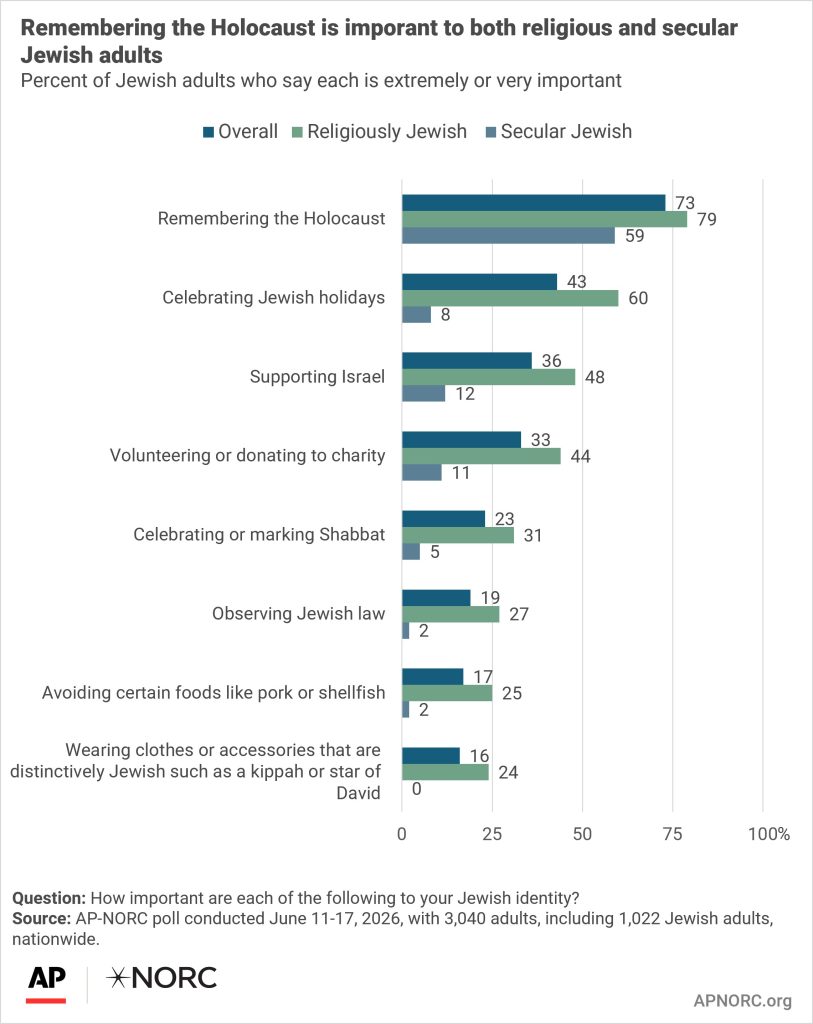
Religiously affiliated Jews tend to feel more connected to Israel than secular Jews. Forty percent of religious Jews feel very or extremely emotionally attached to Israel compared with only 11% of secular Jews. Forty-five percent of secular Jews do not feel connected to Israel at all. While 48% of religious Jews say supporting Israel is a key part of their Jewish identity, only 12% of secular Jews agree. Among Jews, those who are religious are much more likely than secular Jews to say the term “Zionist” describes them extremely or very well (31% vs 6%). Only about 1 in 10 of both religious and secular Jews describe themselves as “anti-Zionist.”
Religiously affiliated Jews are also more likely to say they support Israel as a Jewish state compared with secular Jews (61% vs. 26%). Very few in either group are supportive of an independent Palestinian state, though religious Jews tend to be opposed while secular Jews are more likely to feel they don’t know enough about the issue to have an opinion.
When it comes to Israel’s military operations, 52% of religious Jews say Israel’s ongoing operation in Gaza is justified, compared with 21% of secular Jews. And while 60% of religious Jews do not think Israel’s actions in Gaza amount to genocide, only 27% of secular Jews agree.
Another key division in views on the war in Gaza among American Jews is age. Thirty-seven percent of Jews under age 45 say Israel has committed genocide in Gaza compared to 23% of those 45 or older.
Discussions around Israel are becoming fraught for many Jews. About 4 in 10 Jews have unfollowed or blocked someone or disagreed with family members because of something related to Israel, and 55% say they have been offended by someone’s comments about Israel. Three in 10 have stopped talking to someone due to disagreement surrounding Israel.
Overall, 43% of Jews say being Jewish is very or extremely important in their life.
Remembering the Holocaust is important to a majority of both religious and secular Jews. Religious and secular Jews diverge in their views on the importance of other forms of Jewish observance such as celebrating Jewish holidays, supporting Israel, or observing Jewish law.
The nationwide poll was conducted June 11-17, 2026 using the AmeriSpeak® Panel, the probability-based panel of NORC at the University of Chicago. Online and telephone interviews using landlines and cell phones were conducted with 3,040 adults. The overall margin of sampling error is +/- 2.8 percentage points. Jewish adults were sampled at a higher rate than their proportion of the population to support analysis. Jewish adults were then weighted to reflect their actual share of the population among the U.S. adult population. The overall margin of sampling error for the 1,022 interviews completed with Jewish respondents is +/- 5.0 percentage points.
- Suggested Citation: AP-NORC Center for Public Affairs Research. “Among American Jews, views on Jewish identity and Israel vary by religiosity.” (July 2026). https://apnorc.org/projects/among-american-jews-views-on-jewish-identity-and-israel-vary-by-religiosity/