June 12, 2026
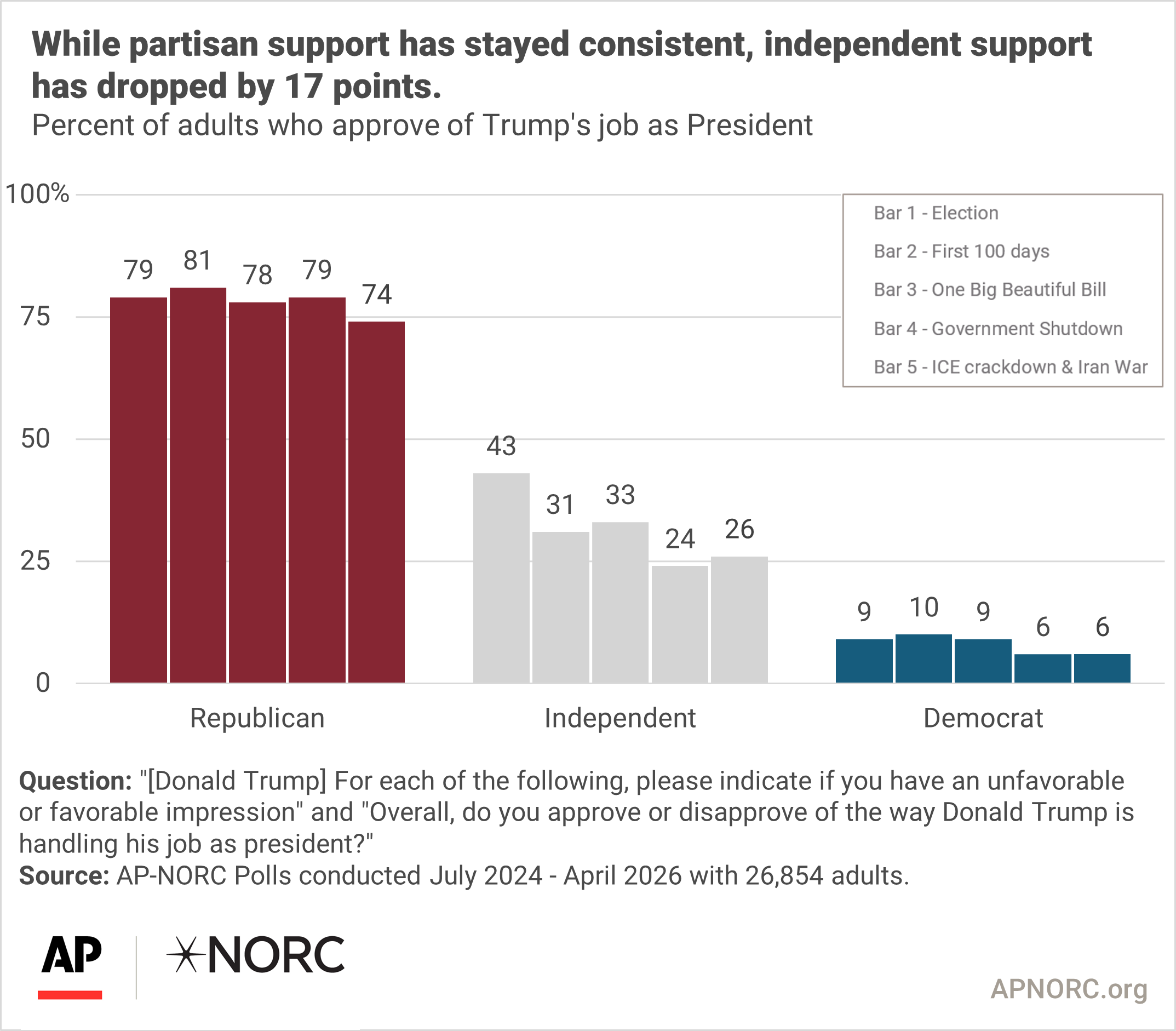
Recent analysis of 21 waves of AP-NORC surveys finds that President Trump’s support among independents has eroded significantly, falling seventeen points from what it was before he took office. This decline has been especially pronounced among independents without a college degree. In contrast, Republican and Democratic support has remained largely stable during the same time period, with Republican support hovering around 75% and Democratic support around 5%.
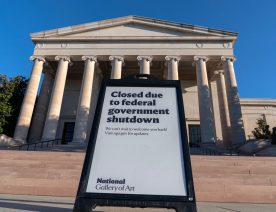
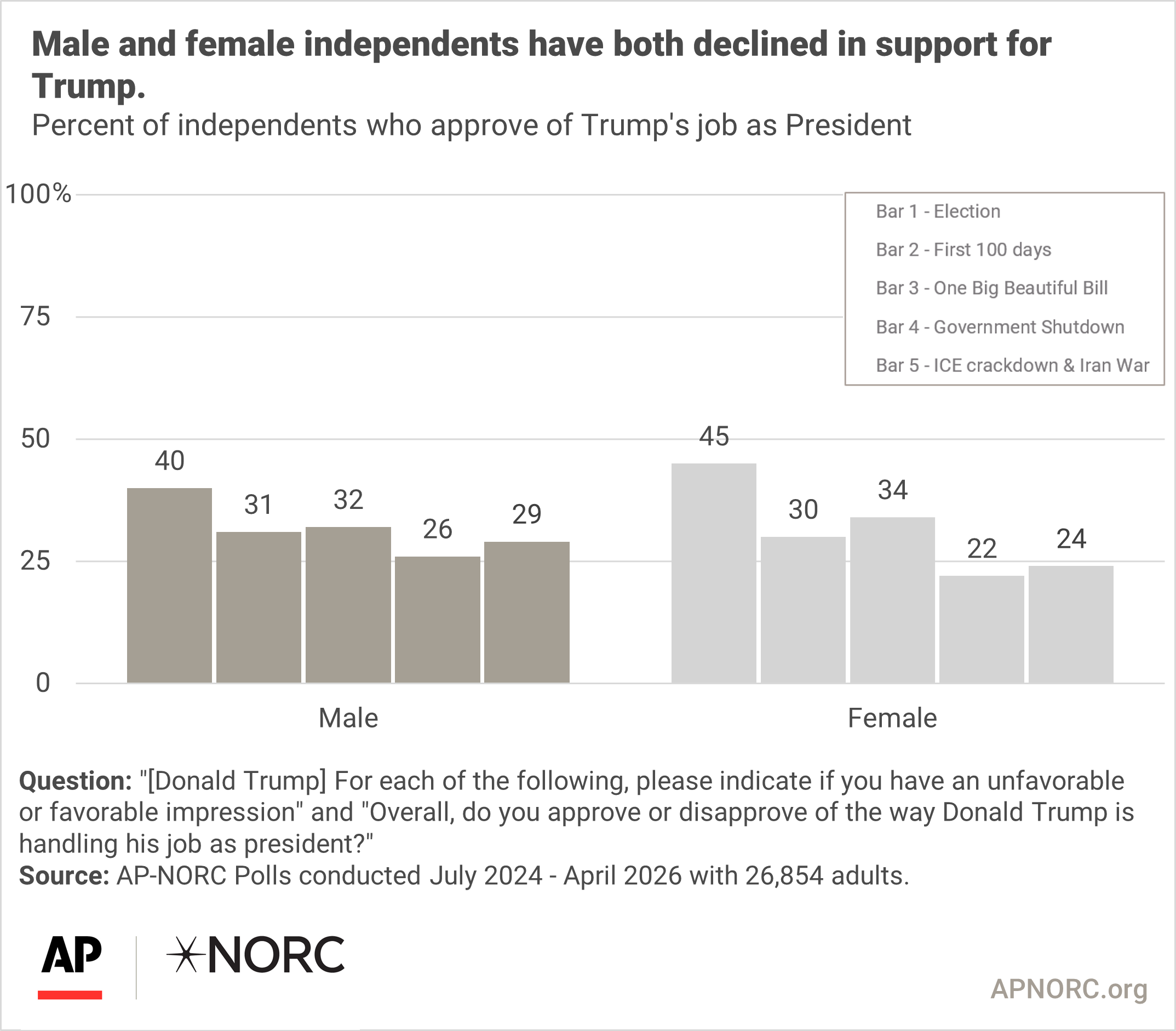
In order to facilitate analysis of independents,[1] survey waves were blocked into five time periods corresponding to: the 2024 election and pre-presidency period (July 2024–January 2025); President Trump’s first 100 days in office (March–May 2025); the period when the One Big Beautiful Bill was passed (June–August 2025); the period of the longest government shutdown in U.S. history (September–December 2025); and January 8–April 20, 2026, a period of domestic ICE-enforcement crackdowns as well as international actions by Trump including the start of the Iran war.
The differences presented in the analysis were also significant in regression models predicting Trump support that controlled for a series of factors including, party identification, gender, race and ethnicity, education, employment status, and age. Full description of the study methodology and analysis can be found here.
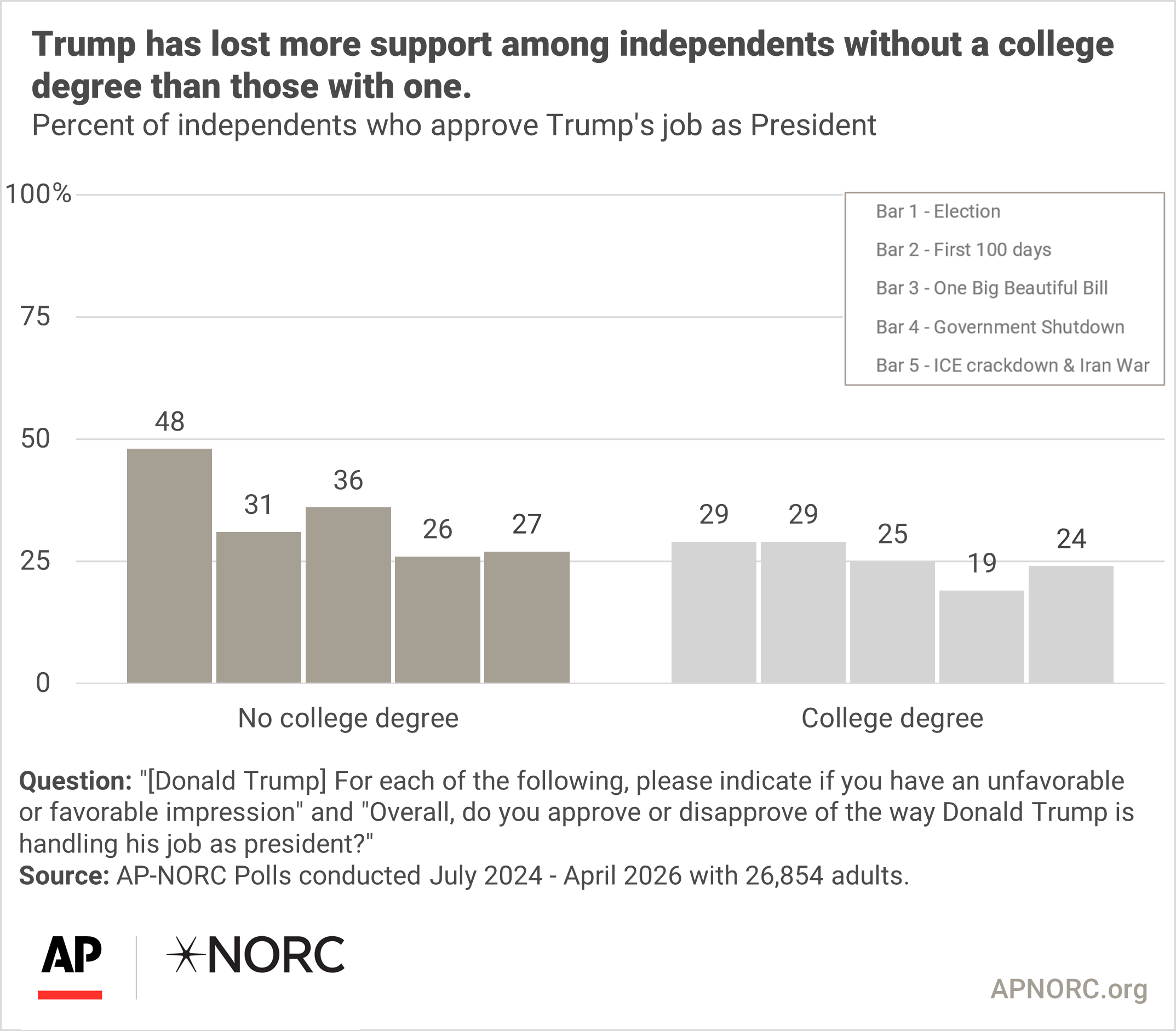
Trump lost more ground among independents without a college degree than those with one, dropping from 48% during the election and pre-presidency period to 27% during the Iran War period. College-educated independents showed less volatility, starting at 29% support during the election and shifting to 24% during the Iran War period.
What started as a clear education gap during the election and pre-presidency period—with non-college-educated independents supporting Trump at higher rates than college-educated independents—is now erased, with both groups showing similarly low levels of support.
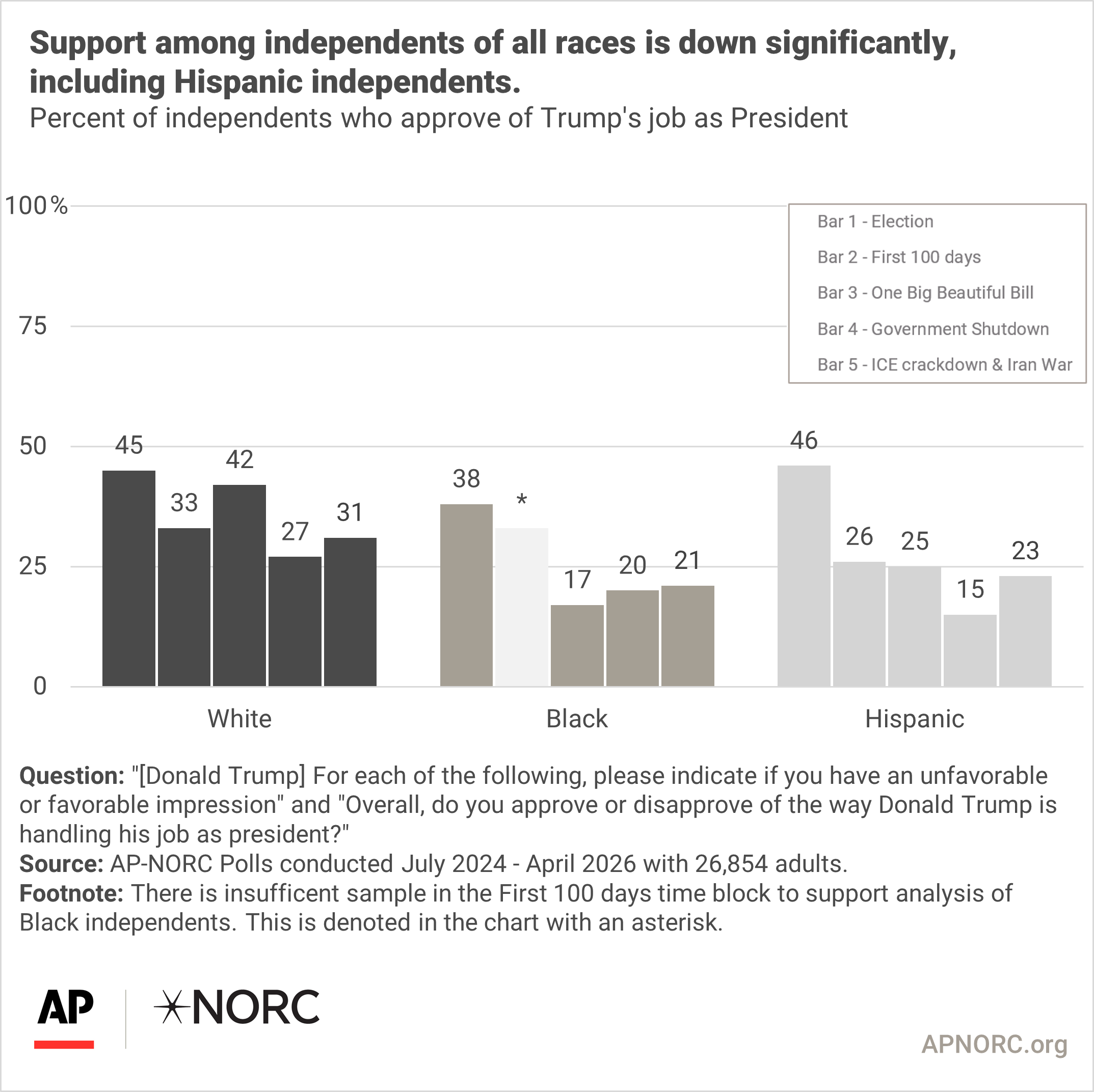
Support for Trump declined among independents across different racial groups, with Black and Hispanic independents showing sharp drops after the election and pre-presidency period. Black independent support fell from 38% during the election to 17% during the One Big Beautiful Bill period, while Hispanic independent support dropped from 46% to 15% during the government shutdown period. Notably, Hispanic independent support dropped by 20 percentage points during Trump’s first 100 days.
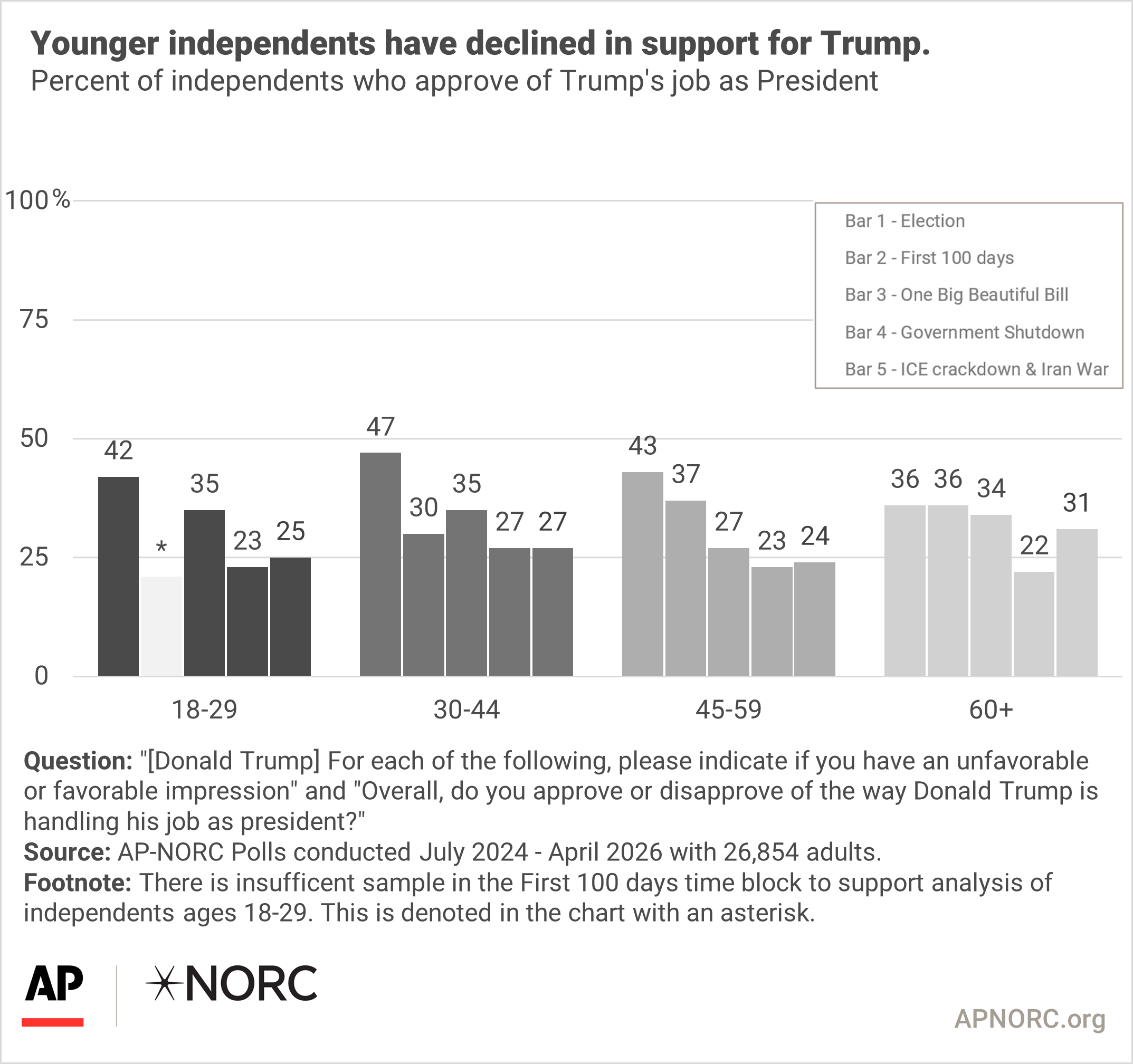
Independents younger than 60 years old have pulled back their support for Trump since the election, while support among those 60 or older has remained relatively stable. Support among 18-29-year-old independents dropped from 42% during the election and pre-presidency period to just 25%. Independents ages 30-59 experienced drops in their approval since the election and pre-presidency period.
Trump lost ground with both independent men and independent women. About 4 in 10 independent men and women supported Trump during the election and pre-presidency period. Around a quarter feel similarly during the Iran War period.
We acknowledge and thank Sean Collins and Tafari Torres for their research contributions to this analysis.
- Suggested Citation: AP-NORC Center for Public Affairs Research. “Trump has lost support from independents over the course of his second term ” (June 2026). https://apnorc.org/projects/trump-has-lost-support-from-independents-over-the-course-of-his-second-term/
[1] Independents are identified using a two-part question: 1. Do you consider yourself a Democrat, Republican, or none of these? 2. Do you lean more toward the Democrats or the Republicans? Respondents who do not select that they identify with nor lean toward either the Democratic or Republican Party are coded as independents. There are 4,836 respondents identified as independents across all five time periods.