

December 17, 2025
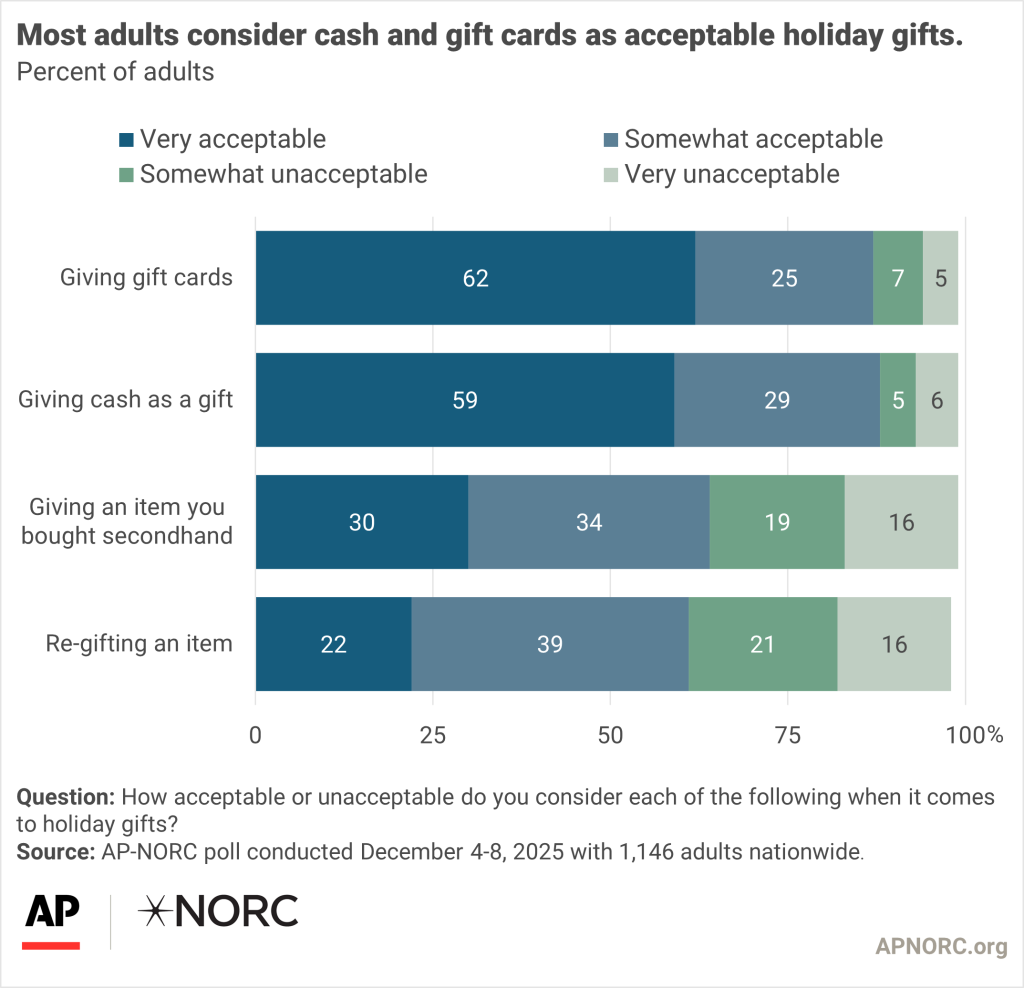
With the holiday gift-giving season quickly approaching, nearly all Americans consider it acceptable to give gift cards or cash as a present. Fewer, though still a majority, consider it acceptable to regift items or gift secondhand items.
Opinions about the suitability of gifts do vary by age. Adults ages 18 to 45 are more likely to say giving a secondhand gift is appropriate compared with adults 45 and older (73% vs 58%). And the acceptability of giving cash or gift cards decreases with age.
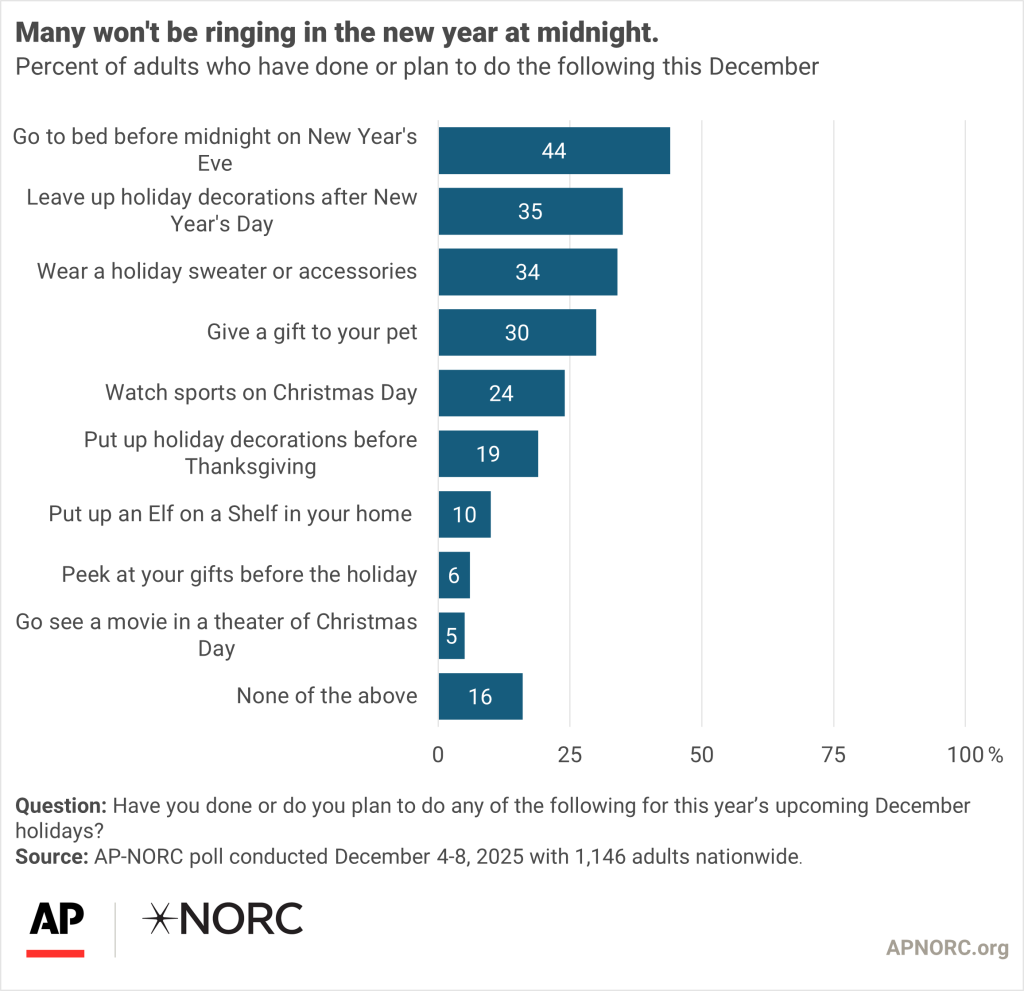
About 4 in 10 adults plan to go to bed before midnight on New Year’s Eve this year. One third expect to leave up holiday decorations after New Year’s, wear festive holiday clothing or accessories, or give a holiday gift to their pet. Two in 10 have put up holiday decorations before Thanksgiving or plan to watch sports on Christmas day. Few adults put up an Elf on the Shelf in their home or peek at their gifts before the holiday.
Men and women celebrate the holidays with different traditions. Women are slightly more likely to leave up their holiday decorations after New Year’s Day (39% vs. 31%) or wear festive holiday attire (42% vs. 25%). About a third of men (31%) expect to watch sports on Christmas day, compared to 18% of women.
Sports viewership on Christmas day is also more popular with adults 45 and older compared with younger adults (31% vs. 17%). And half of older adults (52%) plan to go to sleep before midnight on New Year’s Eve compared with a third (34%) of younger adults.
The nationwide poll was conducted December 4-8, 2025 using the AmeriSpeak® Panel, the probability-based panel of NORC at the University of Chicago. Online and telephone interviews using landlines and cell phones were conducted with 1,146 adults. The margin of sampling error is +/- 4.0 percentage points.
- Suggested Citation: AP-NORC Center for Public Affairs Research. (December 2025). “Gift cards and cash are viewed as more appropriate holiday gifts than second-hand items or regifting.” https://apnorc.org/projects/gift-cards-and-cash-are-viewed-as-more-appropriate-holiday-gifts-than-second-hand-items-or-regifting/