This July 4th will mark the 250th anniversary of the founding of the United States. As America approaches this milestone, Americans express nuanced views not only about whether the American Dream still holds true, but also about the rights and freedoms that define the nation’s identity. Most Americans are proud of the country’s technological achievements and its military. But that pride in various features of the country has been diminishing over the past decade. For example, only 28% have a lot of pride in how U.S. democracy works, down from 42% in 2017.
While freedom or liberty is the most common response when asked what unites Americans, political interests or values is most frequently cited when asked what divides Americans. Still, the American flag is regarded as a symbol of the country’s unity. The public is more likely to consider the American flag as something that brings the country together rather than tears it apart, but few regularly fly the flag at their home
June 8, 2026
The American Dream
Only a third of the public feel the American Dream, the belief that if you work hard, you’ll get ahead, still holds true today. Half say that while the American Dream once held true, it does not anymore. Few, only 15%, say that the American Dream has never been true.
These findings are consistent with previous WSJ/NORC polls in which 31% of adults in 2025 and 34% in 2024 said the American Dream still holds true.
Not all adults are equally likely to believe that the American dream exists. Republicans are more than twice as likely as both independents and Democrats to believe that the American Dream still holds true (57% vs. 24% and 17%, respectively). Additionally, men are more likely than women (39% vs. 29%), and older adults are more likely than younger adults to believe it. Nearly half of adults 60 and older (46%) still believe in the American Dream compared with only a fifth of adults ages 18-29 (22%). White adults are more likely than Black adults to believe that the American Dream currently holds true (40% vs. 19%) while Black adults are more likely to feel that the American Dream has never been true (30% vs. 12%).
Adults born within and outside of the United States are similarly likely to believe that the American Dream still exists.
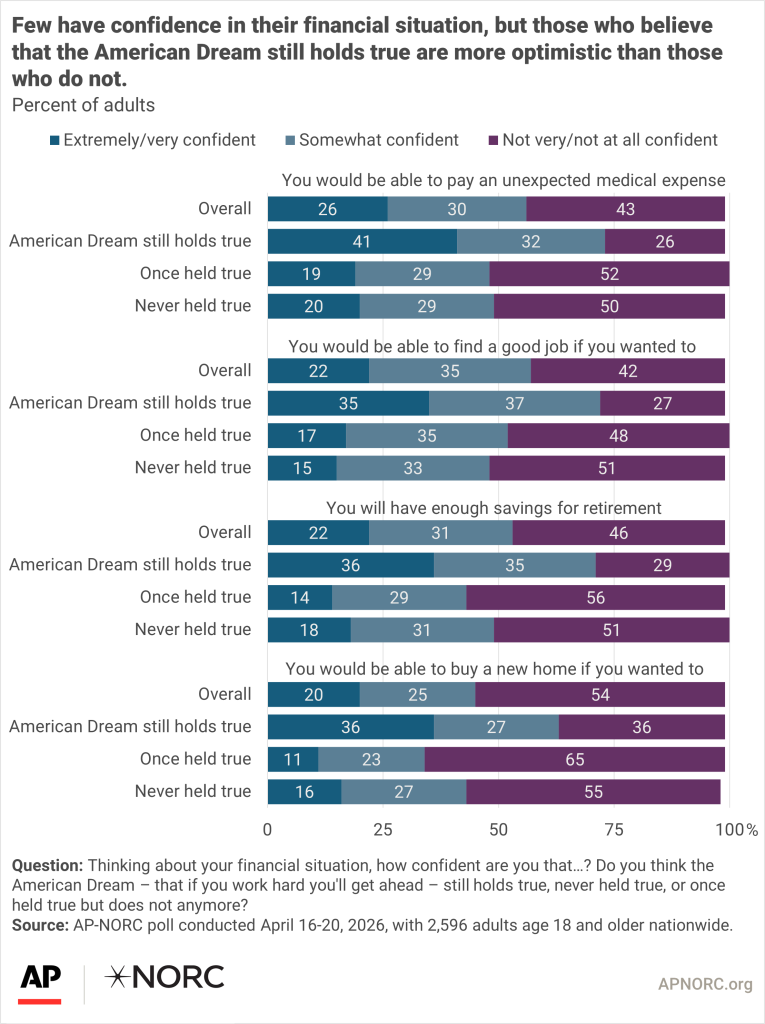
Americans’ views of the American Dream are closely tied to how they see their own economic prospects. Although few adults feel confident about their financial future, those who say the American Dream still holds true are more likely than others to feel confident they can find a good job, save enough for retirement, cover an unexpected medical expense, or buy a new home.
June 17, 2026
The American Identity
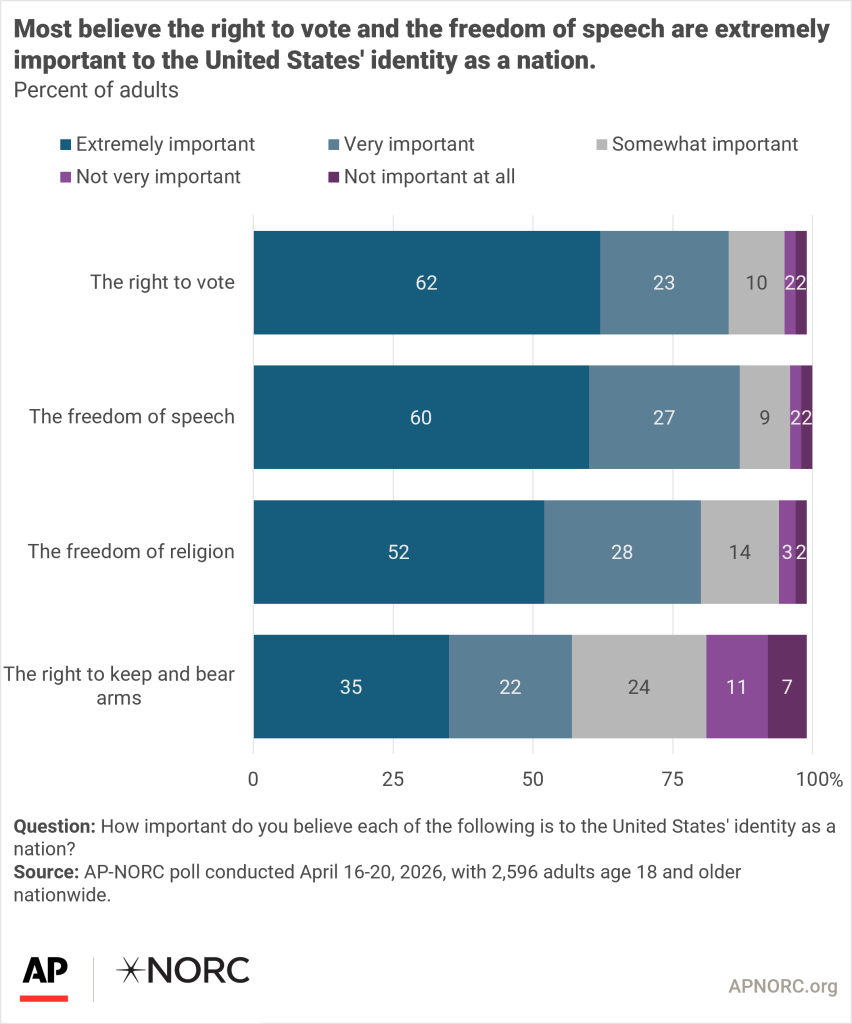
When it comes to America’s identity as a nation, nearly 9 in 10 say the freedom of speech (87%) and the right to vote (86%) are important. Eight in ten believe the same about freedom of religion. Fewer, but still a majority, believe the right to keep and bear arms is important to America’s identity (57%).
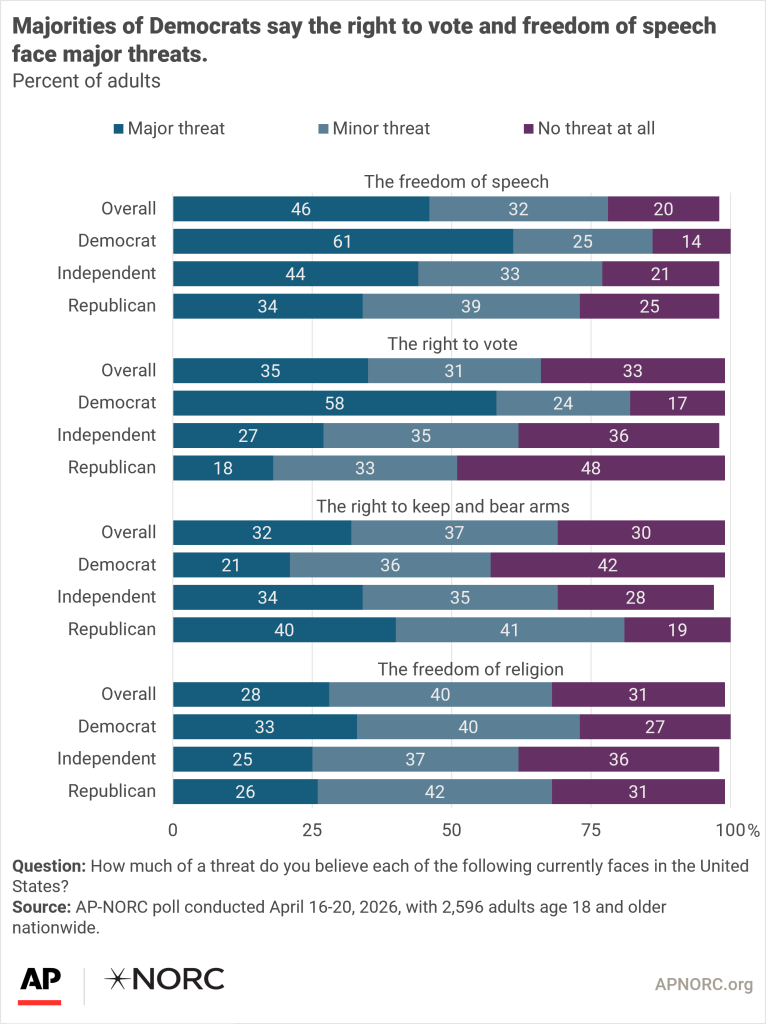
Although most of the public believe that freedom of speech is important to the United States’ identity as a nation, almost half (46%) perceive it as currently under major threat, with another third saying it is under minor threat.
The public is more divided on how much threat the right to vote is currently facing: about a third say it is under major threat, another third say it is under minor threat, and the remaining third say there is no threat at all. A similar pattern emerges regarding the right to keep and bear arms, with roughly similar shares perceiving it as under major threat, under minor threat, or no threat at all.
Fewer say freedom of religion is under major threat, though, 40% perceive it to be under minor threat.
By wide margins, Democrats are more likely than both independents and Republicans to perceive the right to vote or freedom of speech as facing major threat. Partisan differences are smaller when it comes to freedom of religion, with one-third of Democrats saying it faces a major threat, compared with about one-quarter of independents and Republicans. In contrast, Republicans and independents are more likely than Democrats to perceive the right to keep and bear arms as under major threat.
June 25, 2026
What Unites and Divides the Country
When it comes to overall perceptions of the nation, 2 in 10 adults (18%) describe America in one word as “great, prosperous, or powerful.” The next most common descriptors are “struggling or declining” (14%) and “free or freedom” (13%). These results are similar to a 2016 AP-NORC poll in which the same percent of adults described the country as “great or prosperous.”
Republicans are more likely to use positive words to describe the country compared with Democrats who are more likely to draw negative associations. More Republicans than Democrats described the country as “free or freedom” (22% vs. 6%) or “great, prosperous, or powerful” (30% vs. 9%). Alternatively, Democrats were more likely to use words or phrases like “struggling or declining” (22% vs. 6%) or “corruption or unfairness” (13% vs. 4%).
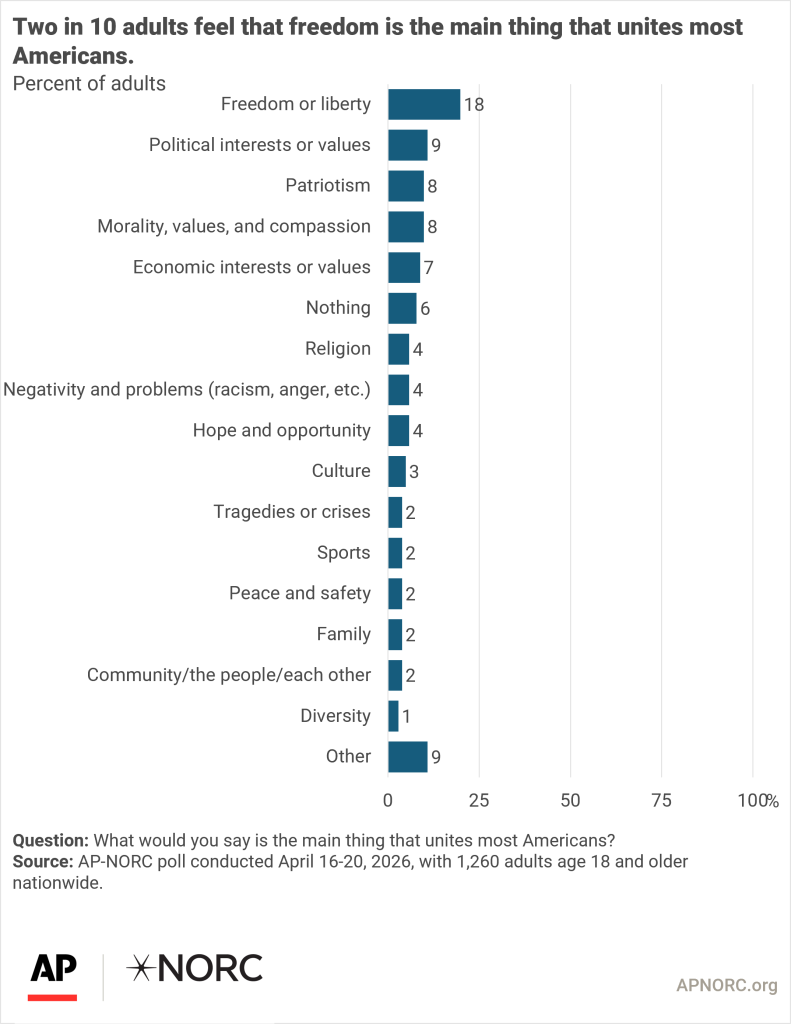
Half of respondents were asked what unites Americans and 2 in 10 cite “freedom or liberty” as the main principle. One in 10 point to “political interests or values,” “patriotism,” or “morality, values, and compassion.” These findings are similar to results from a decade ago, when “freedom or liberty” was also the most common response.
Republicans are more likely to cite “freedom or liberty” as a source of unity in America compared with Democrats (27% vs. 11%).
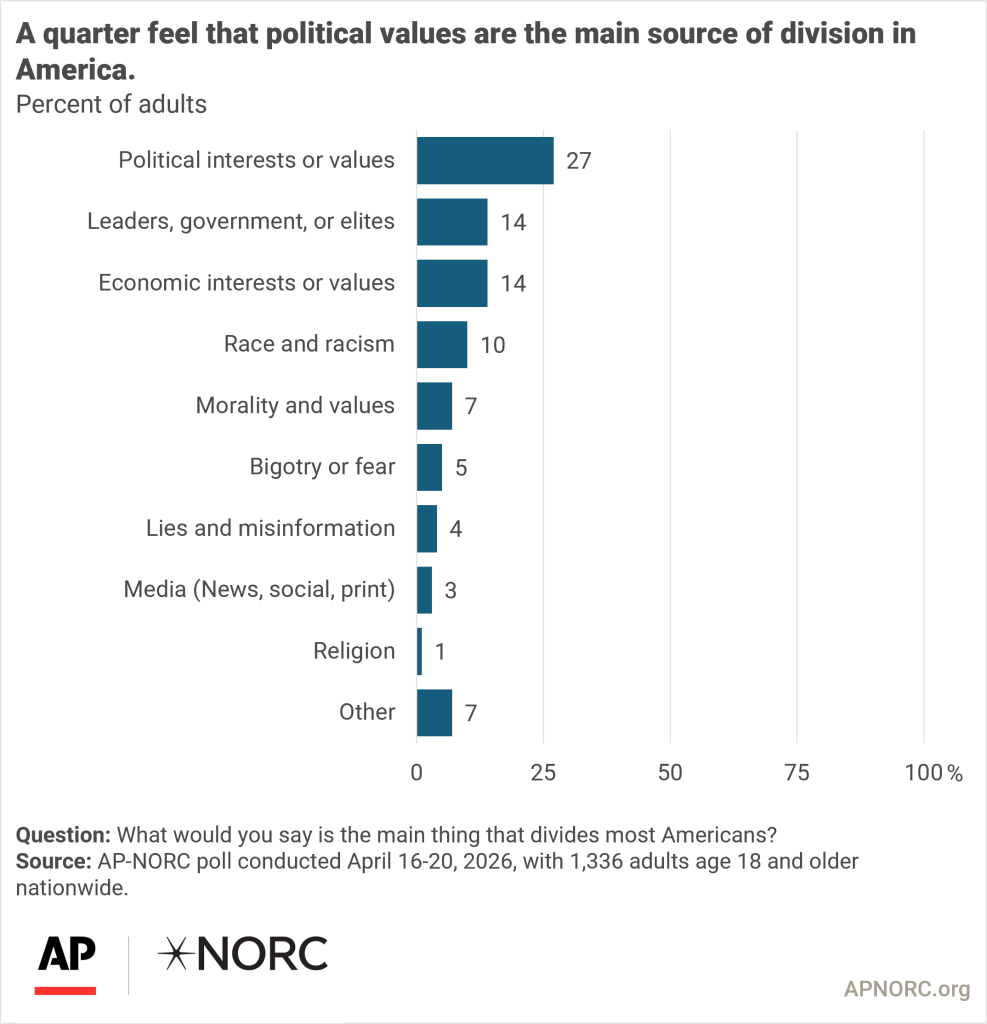
The other half of the respondents were asked about what divides Americans. There is more consensus on the source of divisions. About a quarter (27%) cite “political interests or values” as the main source of division, while 14% blame “leaders, government, or elites.” Another 14% point to “economic interests or values.” These views are similar to 2016, when 25% mostly blamed “political interests or values” and 18% named “economic interests or values” as the main sources of division.
Republicans are more likely than Democrats to say “political interests or values” divide most Americans (37% vs. 24%).Read more:
June 29, 2026
Pride and Personal Identity
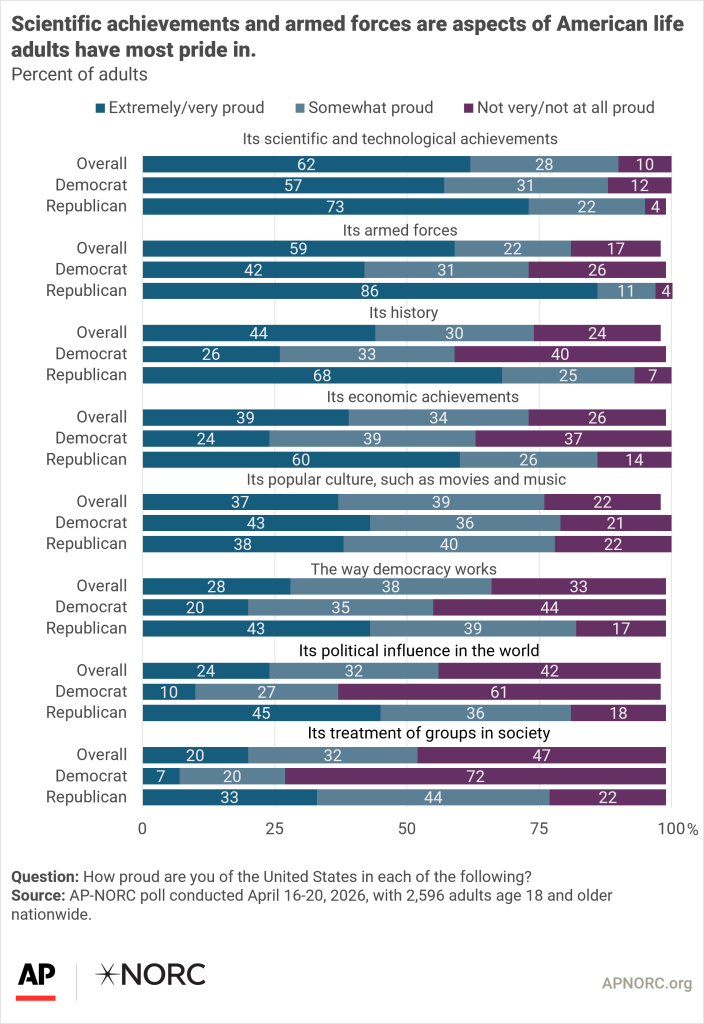
When it comes to finding pride in the country, its history, and institutions, people are most proud of the military and of scientific and technological achievements. Adults experience varying levels of pride in American institutions. Fewer than half are extremely or very proud of America’s history, economic achievements, popular culture, or the way its democracy works. Only a fifth are especially proud of America’s political influence in the world or the way it treats groups in society.
Compared to a 2017 AP-NORC Poll during Trump’s first term, adults are feeling less pride in several aspects of the country. Pride in America’s armed forces (78% vs. 59%), history (58% vs. 44%), democracy (42% vs. 28%), and political influence on the world (34% vs. 24%) have all dropped over the past decade.
Partisan differences are responsible for driving some of these declines in pride. Compared to 2017, Republicans’ pride in the armed forces has remained consistent while Democrats’ pride in the military has dropped substantially (74% vs. 42%). Additionally, while Republican pride in America’s political influence on the world hasn’t changed much compared with 2017 (45% vs. 51%), fewer Democrats now feel prideful (10% in 2026 vs. 26% in 2017).
Forty-seven percent are not very or not at all proud of how America treats different groups in society. In 2017, 35% held that negative opinion. Democrats are largely responsible for increase in disapproval of how America is treating different groups. Seventy-two percent are currently not very or not at all proud of how America is handling treatment of different groups compared with 45% who felt this way in 2017. Republican lack of pride in this attribute of the country is about the same as in 2017.
Republicans are currently prouder than Democrats of all aspects of American society asked about, except for popular culture. Democratic and Republican pride in American popular culture is about the same.
Adults identify multiple factors as important to their personal identity. Family ranks highest, with 81% saying it is extremely or very important. About half feel that being an American (55%) and their gender (53%) are important aspects of their identity. Four in 10 feel the same about their job (42%), religion (42%), ancestry (37%), or race or ethnicity (36%). Political affiliation is important to fewer adults (21%), while about one third (36%) say it is not important.
June 30, 2026
The American Flag and Celebrating the 250th Anniversary
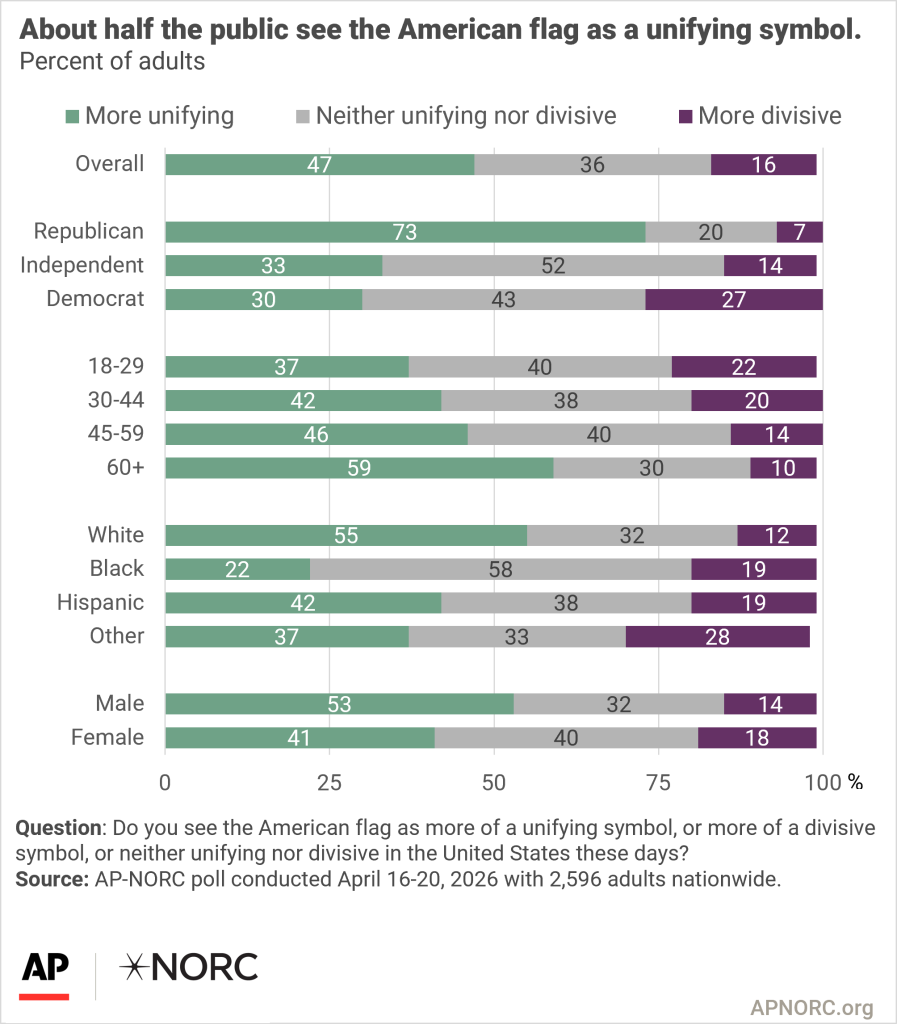
About half of adults (47%) see the American flag as more unifying than divisive in the United States today, compared with 16% who view it as more divisive. Thirty-six percent say it is neither. Republicans are more likely than Democrats or independents to see the flag as more of a unifying symbol than a sign of division. Adults age 60 and older, white adults, and men are also more likely than younger adults, other racial groups, or women to view the flag as unifying rather than divisive.
About 2 in 10 (22%) display the American flag at their homes every day or for most of the year, while 27% say they fly the flag on specific days, such as holidays. Fifty percent never display the American flag at their homes.
Republicans are more likely than Democrats or independents to fly the American flag at their home either every day or on holidays.
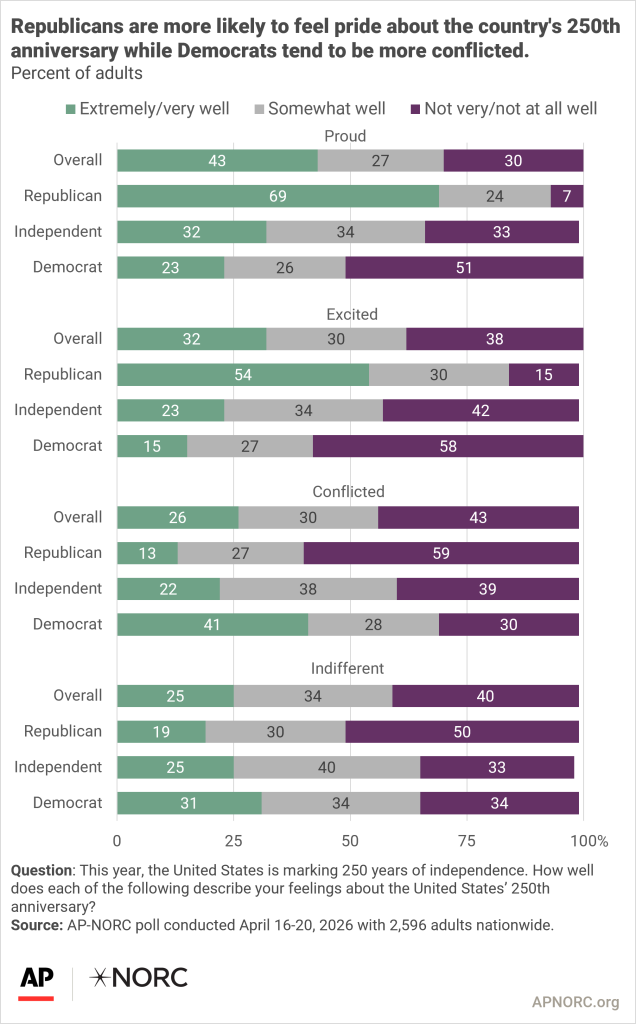
About 4 in 10 U.S. adults feel “proud” about the country’s 250th anniversary and about a third say “excited” describes their emotions. The president formally kicked off the celebrations on June 24 with a rally on Washington’s National Mall, a series of flyovers by stealth bombers, and music from military bands.
However, some Americans don’t care or feel ambivalent about the anniversary. A quarter say they are feeling “conflicted” and about the same number are “indifferent”.
Republicans are much more likely to say the anniversary makes them feel “proud” or “excited” than Democrats or independents. Four in 10 Democrats feel “conflicted” about the country’s 250th birthday.
Fewer Americans say democracy is central to country’s identity, AP-NORC poll finds
Most Americans see freedoms under threat but core to nation’s identity, AP-NORC poll finds
How Americans are feeling about the country’s 250th anniversary, according to new polls
We asked more than 2,500 Americans to describe the United States in one word.
Americans’ pride in US history and democracy drops, and fewer are proud to be American, polls find
Who flies the American flag for holidays — and who never flies one, according to an AP-NORC poll
The nationwide poll was conducted April 16-20, 2026 using the AmeriSpeak® Panel, the probability-based panel of NORC at the University of Chicago. Online and telephone interviews using landlines and cell phones were conducted with 2,596 adults. The overall margin of sampling error is +/- 2.6 percentage points.
- Suggested Citation: AP-NORC Center for Public Affairs Research. “AP-NORC America 250 Poll” (June 2026). https://apnorc.org/projects/ap-norc-america-250-poll/