
June 15, 2026
To explore how AAPI adults view the United States as the country prepares to celebrate the 250th anniversary of its independence, a new AAPI Data/AP-NORC poll asks respondents to describe the country, and what unites and divides Americans in their own words. Much like the general population, top words used to describe the United States are great, prosperous, or powerful (20%), with freedom and liberty uniting most Americans (18%). One in 3 AAPI adults say that politics is the main thing dividing Americans.
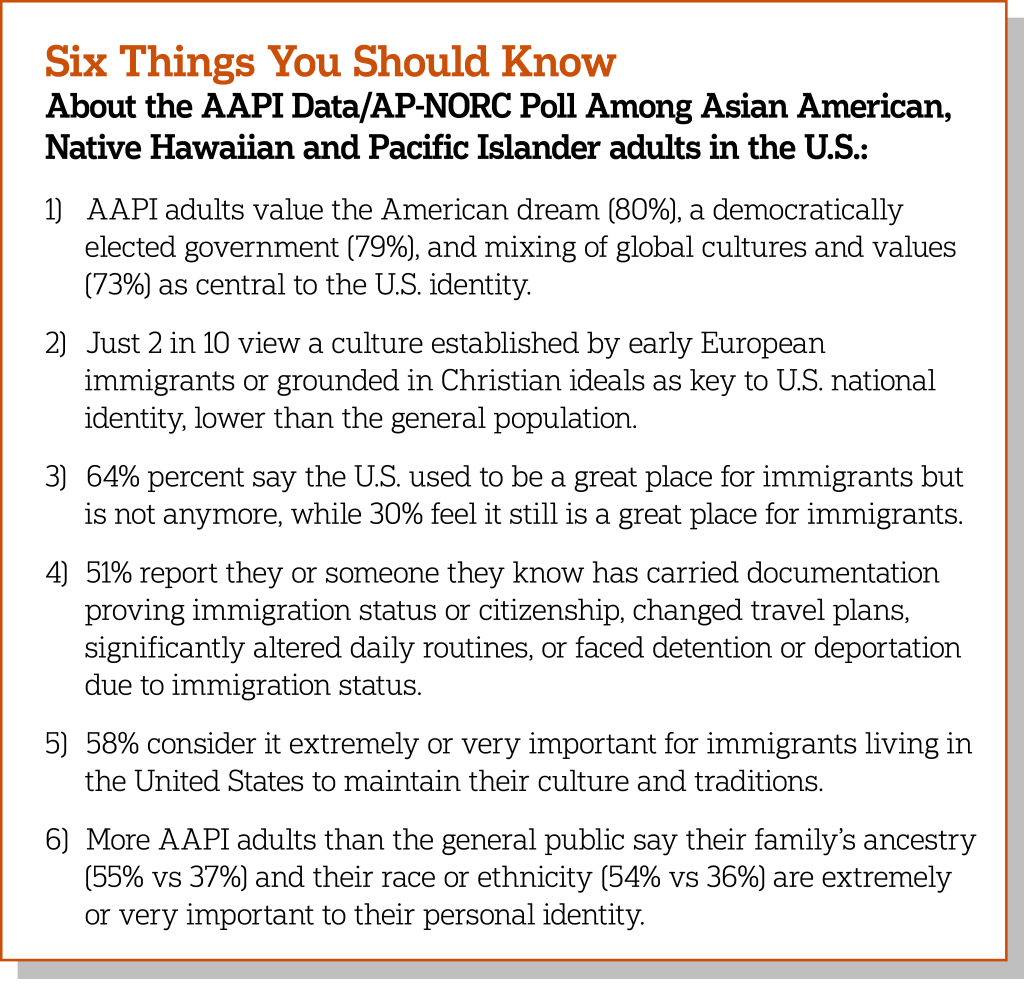
The poll also finds that AAPI adults value the American dream (80%), a democratically elected government (79%), and the mixing of cultures and values from around the world (73%) as core parts of the United States’ identity as a nation. They are less likely than the general population to consider a culture grounded in Christian religious beliefs (20%) and established by early European immigrants (21%) as important to its identity.
Just 1 in 3 AAPI adults view the United States as a great place for immigrants while 64% say it used to be a great place but is not anymore. Half of AAPI adults have altered their own behaviors or know someone who has because of their immigration status. Forty-one percent of AAPI adults say they have started carrying proof of immigration status or citizenship, or know someone who has, and 34% say the same about changing travel plans because of immigration status. These are both higher than the rates among the general population (25% and 18%, respectively).
And as the Supreme Court looks at limits on birthright citizenship, AAPI adults and the general population are largely in agreement on who should be considered a citizen. Most agree that children born to parents who are in the country legally on work visas should be citizens (81%), and about half say the same about those who are born to parents in the country on tourist visas (56%) and to parents who are in the country illegally (54%).
Most AAPI adults consider it extremely or very important for immigrants living in the United States to maintain their culture and traditions (58%). About half say the same about speaking English fluently (54%), maintaining their language spoken at home (49%), and blending into American society (48%).
Half of AAPI adults consider the United States one of the greatest countries in the world. Thirty-four percent say there are other countries that are better, while 18% say the United States stands above all others.
When asked to describe their feelings about upcoming anniversary, about a third describe themselves as indifferent (34%), conflicted (33%), proud (33%), or excited (28%).
The study also explores questions of personal identity, and found that family ancestry, race, and ethnicity are more important to AAPI adults than to the general population. About half find each extremely or very important, compared with about a third of adults overall. Family (80%) is the most important factor, while gender (50%), job and career (49%), and being an American (44%) are also key aspects of identity.
The nationwide study was conducted by The AP-NORC Center for Public Affairs Research and AAPI Data from April 20-28, 2026, using the Amplify AAPI Monthly Survey drawing from NORC’s Amplify AAPI® Panel designed to be representative of the U.S. Asian American, Native Hawaiian, and Pacific Islander household population. Online interviews were offered in English, the Chinese dialects of Mandarin and Cantonese, Vietnamese, and Korean with 1,075 Asian American, Native Hawaiian, and Pacific Islanders aged 18 and older living in the United States. The margin of sampling error is +/- 4.4 percentage points.