October 21, 2026
As the 2026 midterm elections approach, Americans express mixed views about the integrity of the electoral process. About half of registered voters say they are confident votes will be counted accurately, though confidence varies by party. At the same time, voters express concern about a range of election-related issues, including AI-generated misinformation and partisan gerrymandering, while confidence in the Supreme Court’s ability to handle election-related disputes fairly has declined since 2024.
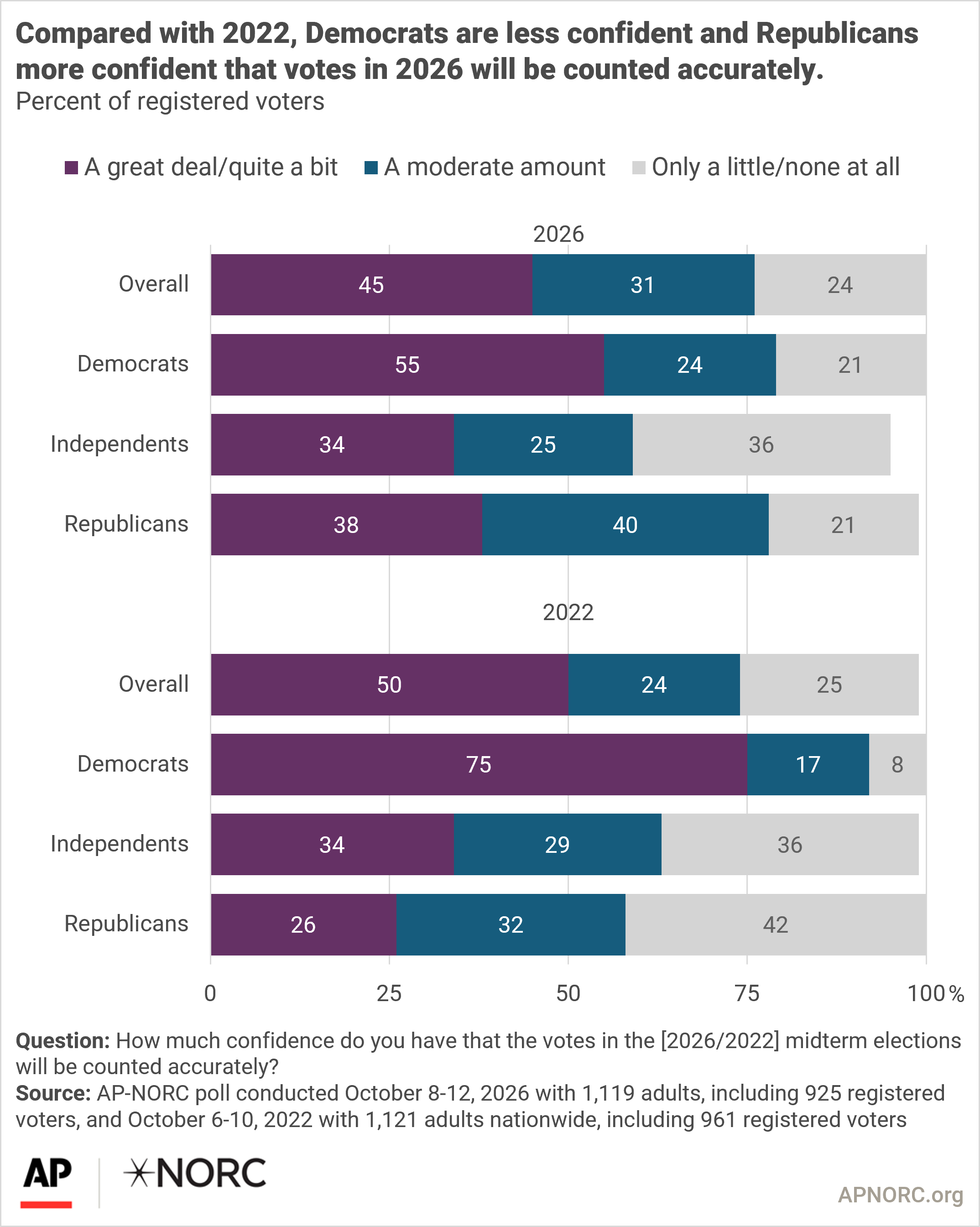
Just under half of registered voters have a great deal or quite a bit of confidence that votes in the 2026 midterm elections will be counted accurately. Democratic voters are more confident than Republican voters in the accuracy of the vote count. Compared with the 2022 midterms, when Joe Biden was president, confidence has declined among Democrats and increased among Republicans.
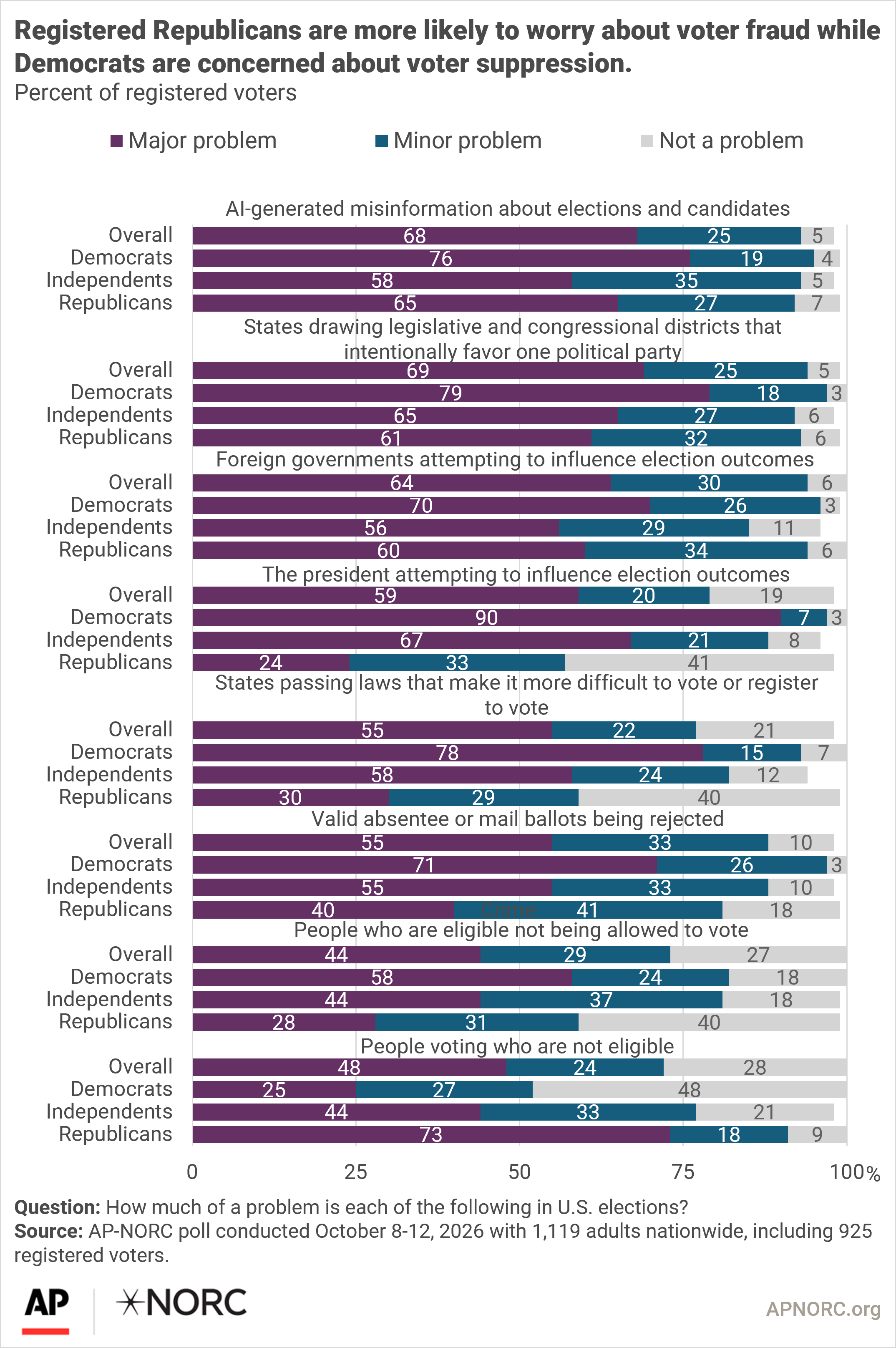
About 7 in 10 voters say AI-generated misinformation and states drawing legislative and congressional districts that intentionally favor one political party are major problems in U.S. elections. About 6 in 10 say foreign governments attempting to influence election results and the president attempting to influence election outcomes are major problems. More than half say state laws that make it more difficult to vote or register to vote and valid absentee or mail ballots being rejected are major problems in U.S. elections. Fewer say the same about voter suppression (people who are eligible not being allowed to vote) or voter fraud (people voting who are not eligible).
Voters are more likely now than they were before the 2024 general and 2022 midterm elections to say state gerrymandering (69% vs. 57% and 64%) and voter fraud (48% vs. 40% and 35%) are major problems.
Republican voters are more likely than they were before both the 2024 and 2022 elections to say voter fraud is a major problem (73% vs. 63% and 59%) while Democrats’ views have remained largely unchanged, with about 2 in 10 saying the same across elections.
Similar shares of Republican and Democratic voters view AI-generated misinformation about elections and candidates as a major problem. Republican voters are more likely than Democratic voters to say people voting who are not eligible is a major problem, while Democratic voters are more likely than Republican voters to say each of the other issues listed are major problems in U.S. elections.
Only 17% are extremely or very confident that the U.S. Supreme Court will deal with any cases involving the midterm elections in a fair and nonpartisan manner, while 31% are somewhat confident and 50% are not very or not at all confident. Confidence has declined from 24% in October 2024.
Most voters favor requiring all voters to provide valid photo identification at their voting place in order to cast their ballot (72%) and proof of U.S. citizenship when they register to vote (67%). Fewer support allowing citizens to register and vote on the same day (54%) or automatically providing a mail-in ballot to all registered voters (46%).
The nationwide poll was conducted October 8-12, 2026, using the AmeriSpeak® Panel, the probability-based panel of NORC at the University of Chicago. Online and telephone interviews using landlines and cell phones were conducted with 1,119 adults, of whom 925 say they are registered to vote. The overall margin of sampling error is +/-3.9 percentage points.
- Suggested Citation: AP-NORC Center for Public Affairs Research. “Just under half of voters are very confident that votes in the upcoming midterms will be counted accurately” (October 2026). https://apnorc.org/projects/just-under-half-of-voters-are-very-confident-that-votes-in-the-upcoming-midterms-will-be-counted-accurately/