October 19, 2026
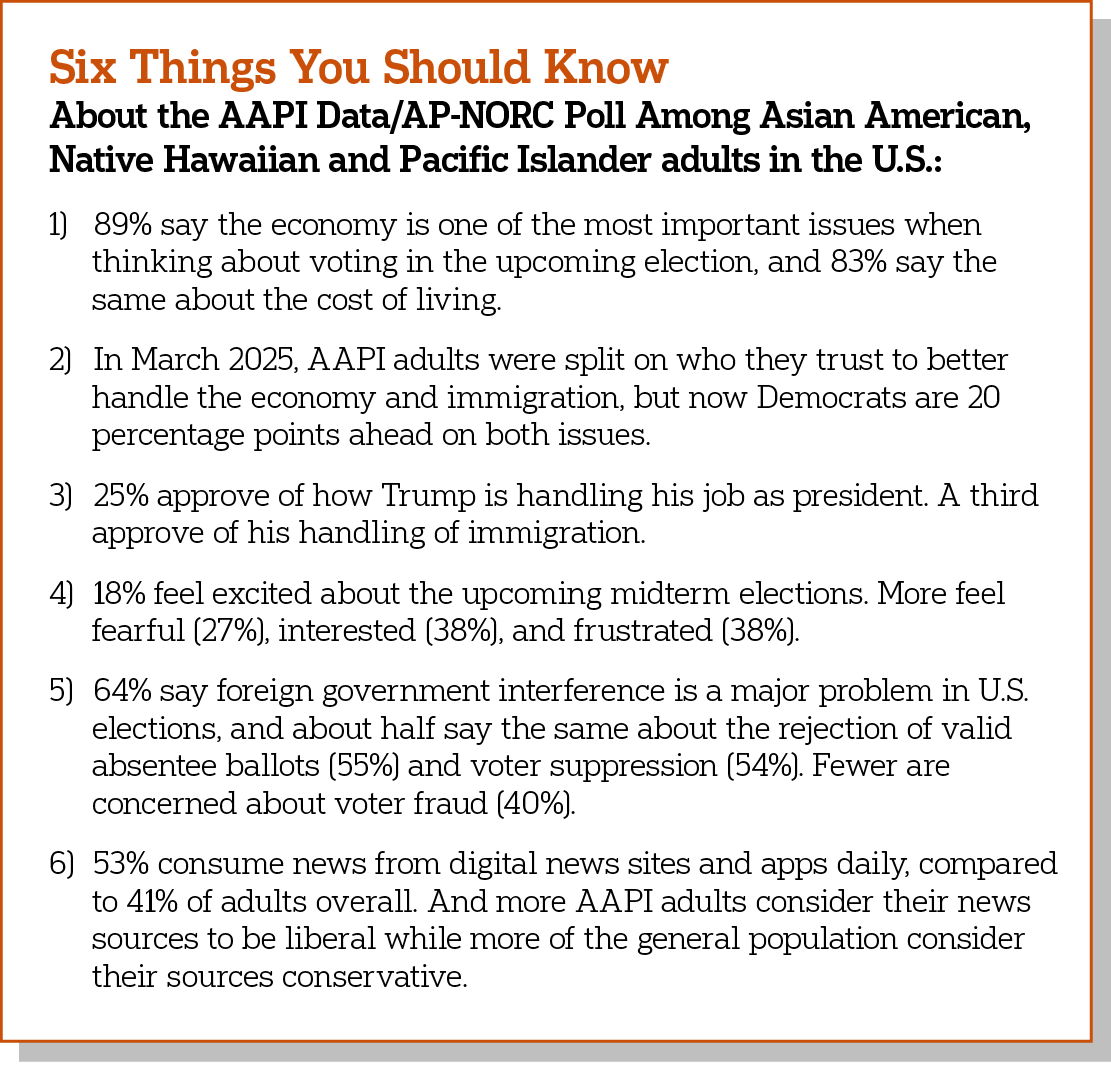
The economy is top of mind for AAPI adults ahead of the midterm elections. The September AAPI Data/AP-NORC poll finds that 89% of AAPI adults consider the economy as one of the most important issues when thinking about voting in the upcoming election, and 83% say the same about the cost of living. Seventy-three percent say health care is one of the most important issues. On each of these issues, AAPI adults are more likely to trust the Democratic party to do a better job handling them than the Republican party.
These issues are also top of mind for the general population, who also trust the Democrats to handle them more so than the Republicans, though to a lesser extent than AAPI adults.
The Republican party has lost ground with AAPI adults on their handling of certain issues. In March 2025, AAPI adults were split on who would better handle the economy (31% the Democrats vs 28% the Republicans) and immigration (31% the Democrats vs 35% the Republicans). Now, 41% say they trust the Democrats on the economy compared with just 21% who say they trust the Republicans. Similarly, 43% now trust the Democrats on immigration compared with 24% who trust the Republicans.
Overall, AAPI adults express a range of feelings about the upcoming election. Just 18% say excited describes the way they feel very or extremely well. But about 4 in 10 feel interested or frustrated. Twenty-seven percent feel fearful. Ahead of the most recent presidential election in 2024, more AAPI adults said they felt both fearful (37%) and excited (29%).
When it comes to concerns about the elections, most AAPI adults view attempts by foreign governments to influence U.S. election outcomes as a major issue (64%), and about half say the same about valid absentee or mail ballots being rejected (55%) or eligible people not being allowed to vote (54%). Four in 10 say voter fraud is a major issue. And many AAPI adults are also extremely or very concerned about fake or false information about the candidates (56%), legal challenges to the election results (48%), violence after the election (45%), and threats of violence at the polls (41%).
Looking at the current administration, just 27% of AAPI adults have a favorable view of Trump and just 25% approve of how he is handling his job as president. These findings are similar to how AAPI adults viewed the president at the beginning of the year. His current ratings are also similar to views on how Trump is handling the economy (22%), foreign policy (22%), health care (25%), and immigration (32%). And few AAPI adults have a favorable opinion of the Republican party (26%). Forty-four percent view the Democratic party favorably while 48% have an unfavorable opinion.
The survey also asked about news consumption habits and found that the most frequently used sources for news and information on a daily basis are digital news sites and apps (53%), social media platforms (53%), and television and streaming (44%). AAPI adults are more likely to use each news source asked about than the general population, other than television and streaming. Those who consume news on everyday are more likely to report feeling positive emotions such as interest in or excitement about the upcoming midterm elections than those who consume news less frequently. The frequency of news consumption does not impact the share of people feeling fearful or frustrated.
The nationwide study was conducted by The AP-NORC Center for Public Affairs Research and AAPI Data from September 8-15, 2026, using the Amplify AAPI Monthly Survey drawing from NORC’s Amplify AAPI® Panel designed to be representative of the U.S. Asian American, Native Hawaiian, and Pacific Islander household population. Online interviews were offered in English, the Chinese dialects of Mandarin and Cantonese, Vietnamese, and Korean with 1,023 Asian American, Native Hawaiian, and Pacific Islanders aged 18 and older living in the United States. The margin of sampling error is +/- 4.7 percentage points.